Sophie Bannan

I Saw My Mother and She Saw Me: Subjectivity as a Democratic Provocation

Article Detail

This essay was selected as one of two runner-up entries in the 2025 Michèle Whitecliffe Art Writing Prize.

The theme for this year’s prize was The Visual Arts and Democracy. At a time when established democracies around the world are facing instability and the erosion of norms, active and inclusive participation in society is crucial. Strong democratic systems thrive on the voices of their people being heard and on collective engagement. Art has long been at the heart of political life – persuading, empowering and fostering vital dialogue.

The judge this year was Hannah Mathews, Director/CEO of the Perth Institute of Contemporary Arts (PICA). Matthews commented on this essay by Sophie Bannan, "This essay takes a refreshing lateral approach to exploring art and democracy, framing subjectivity not as a limitation but as a democratic provocation that embraces multiplicity and chaos. It thoughtfully contrasts two local art projects—Daegan Wells’s ecological, queer farming practice and Joyce Campbell’s dream diaries and LiDAR landscapes—revealing how their deeply personal yet community-rooted works challenge colonial histories and hegemonic narratives. The juxtaposition highlights the nuanced ways art can reimagine time, space and democracy by centring lived experience and ecological interconnection. Overall, the essay offers an insightful, layered meditation on how subjective perspectives can expand democratic possibilities in art and life". 

Read the winning essay:

Flag on the Floor: Art, Protest and the Limits of Democratic Imagination

Read the other runner-up essay:

Artistic Autonomy, Institutions and the Living Forum

--------------------------------------------------------------

In a way the total picture of our time is the abstract sum total of the awareness of all the creatures who live in it. No matter what power chooses to do. It’s the greatest loss, the irreverence and disregard for the rich chaos of knowledge and presence that defines life on this fading planet. 

Eileen Myles, 'Time Puts Its Stamp on Everything'

From Daegan Wells’ farm in Ōraka Colac Bay, he can see Rakiura Stewart Island. Which is to say it’s basically as far south as you can get. As a child, Wells lived in nearby Manapouri, while his engineer father worked on the power station’s second tunnel construction. A decade or so ago, Wells returned to Manapouri from his base in Ōtautahi to harvest clay from the lakeside and met his now partner, Scott.

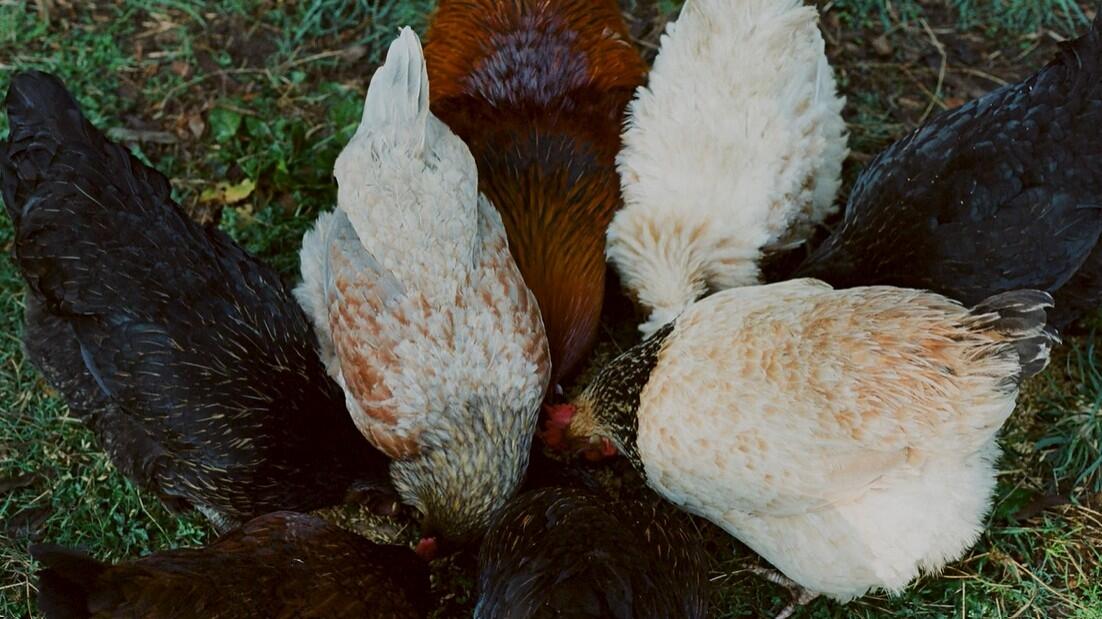
The Colac Bay farm has been in Scott’s family for generations. Together, they live in a cottage on the farm with their dog, chickens, sheep and a vegetable garden. On this working dairy farm, Scott challenges embedded farming practices with direct ecological interventions. They must be something of a Southland oddity: a young, queer farming couple, Wells thudding away at his loom, or gathering posies of crimson clover from the grazing paddocks.

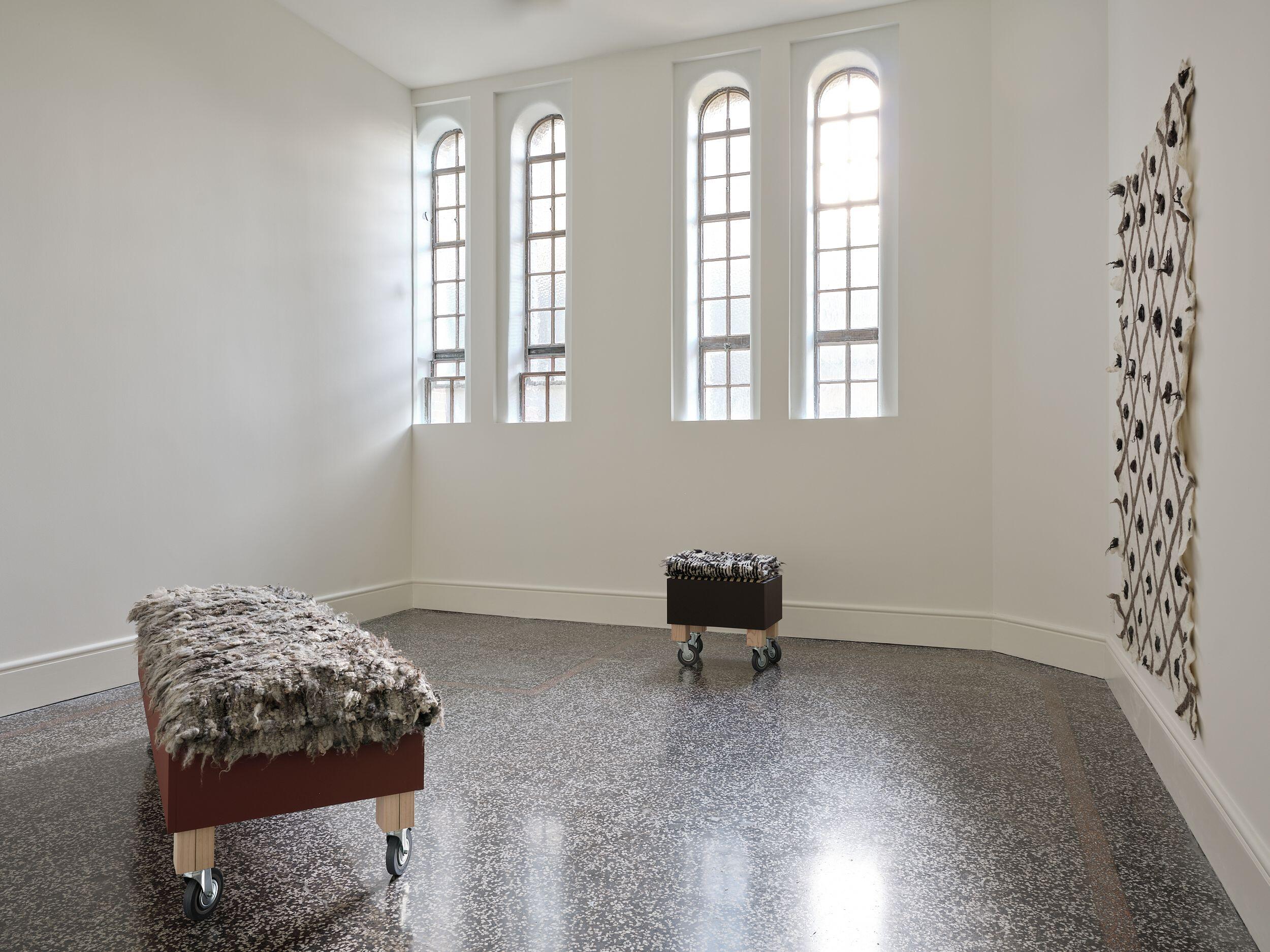
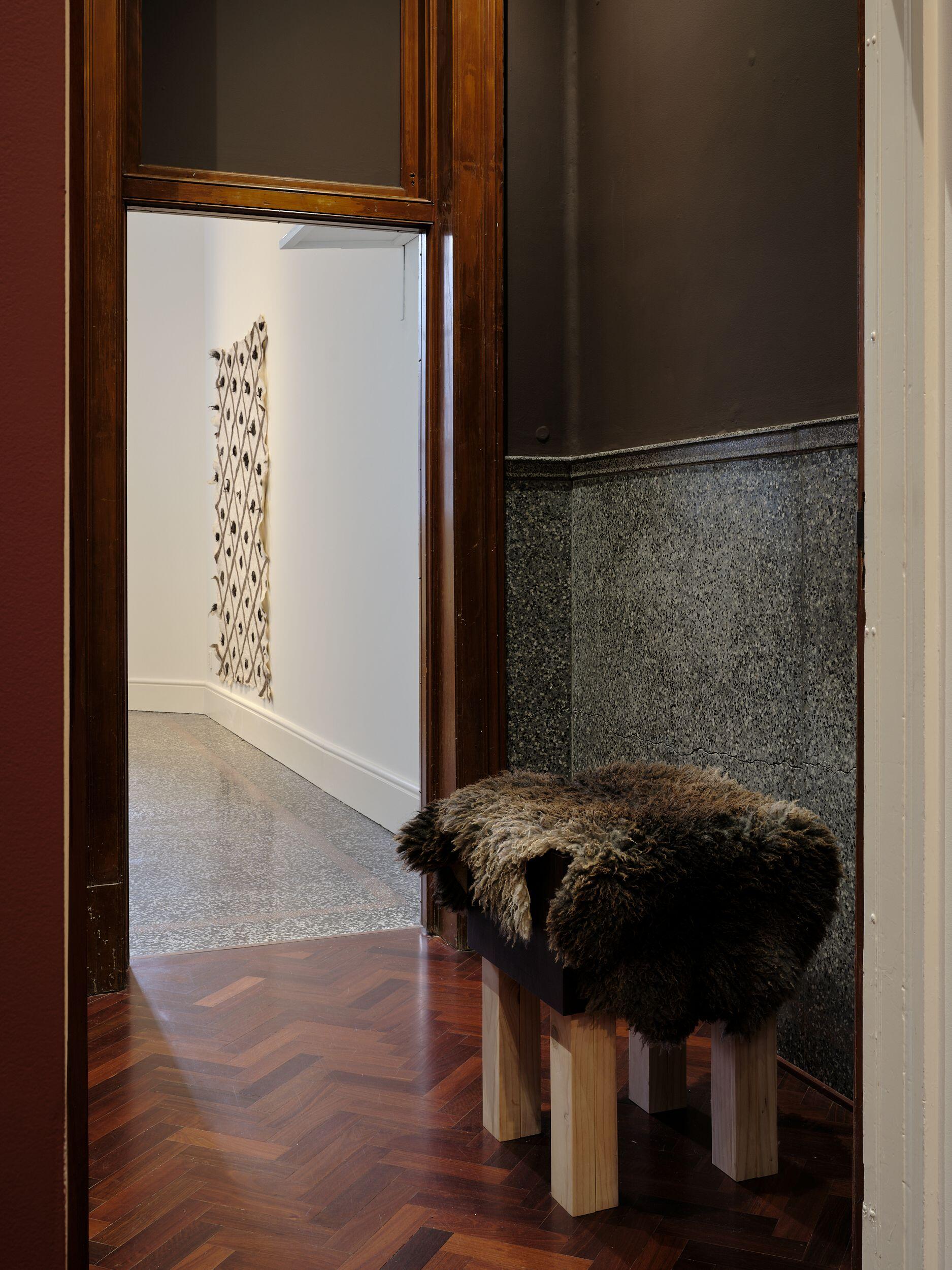
Because of where I live is Wells’ recent body of work, exhibited at Auckland’s Gus Fisher Gallery and commissioned as part of their Changing Room programme. The large atrium space with its historic stained-glass dome ceiling branches off into a small antechamber, where Wells has placed the pelt of a pet sheep. I can smell her. She didn’t have a name and the rest of her is in the freezer back at the farm cottage. While describing the process of scraping fat from the underside of her hide, Wells strokes the pelt, greasy sprigs of liver-coloured fleece between his fingers. Her skin is draped over a four-legged, roughly sheep-scaled, raw pine stool. The stool’s hard rectangular edges contrast wholly with the frizzy sheepskin, though I picture Wells planing down this timber scavenged from the farm’s woodshed, planing it smooth with the same repetitive abrasion performed on his pet sheep’s fatty underlayer.


Queer theorist Jack Halberstam describes ‘queer time’ as an experience of human life that operates distinctly from heteronormative life times, lives that are punctuated by assumed milestones such as marriage and parenthood. Halberstam calls to embrace the chaos of ‘symbolic ruptures’ of heteronormativity, a ‘chaos’ encapsulating lives lived in fluid relation to ‘traditional’ narratives. [1] I like to visualise this chaos, the concurrency of queer lives being lived. It gives me the same joyous existentialism as thinking about the enormity of the universe or preparing a meal with cats and babies tumbling around on the kitchen floor beneath me. The chaoses are not distinct, however, and operate relationally and reactionally: personal chaos, environmental chaos, political chaos, the chaos of a life lived in active critique of societal expectations. Halberstam proposes applying an ecological framework to thinking about sex and gender, ‘understanding that changes in one environment inevitably impact changes in other environments. Gender here might be thought of more as a climate or ecosystem and less as an identity or discrete bodily location.’ [2] Where power chooses to value capitalist frameworks for ‘progress’ that disregard existing ecosystems – both in the ecological sense as well as the chaos of all the small lives being lived, queer or otherwise – power inherently disregards democracy. 

When I met Joyce Campbell she was living in the Karekare hills after recently returning from Los Angeles. Her two children were young at the time, and Campbell appeared to me to embrace chaos in an astonishing way. In 2011, Catherine Opie was artist in residence at Elam School of Fine Arts, where Campbell taught and I was an undergraduate student. Campbell arranged a trip for Opie and a group of students to Ahipara, and both women had their kids in tow; Opie with her wife and young son, Campbell with a still breastfeeding toddler and her son, Moses, who celebrated his eighth birthday during the trip. We arrived at the marae later than planned – it was dark early in July – and bags of button mushrooms had been sweating in the van so that they were slimy and bruised by the time we arrived at our accommodation. I picture Campbell’s sleeves rolled up, baby on her hip, overseeing the meal preparation with eccentric hand gestures, rummaging for cutlery, laughing away at the whole chaotic situation. Coming myself from residual Victorian order, I saw Campbell’s comfort with chaos as communicating an openness, a certain intimacy of lives – work, artwork, personal life – that until then I experienced as distinctly, actively, separate. That is to say, my life was organised into categories for the very purpose of circumventing the eruption of chaos. With a young child of my own now and similarly concurrent practices of teaching, art making and parenting, I often find myself trying to channel Campbell as she was in Ahipara to quell my rising panic, to let the lovely chaos be. 

Campbell’s dream diaries were written around this same time. ‘The Boy Made of Rock’ was dreamt by Moses at age seven, so some time not long before the Ahipara trip. She transcribed her own dreams and those of her family, dreams set in the rugged Karekare landscape. What I experience in reading these dreams is an almost uncomfortable intimacy, both at the fantastically symbolic nature of dreams as emerging from the depths of one’s psyche, and the intimacy of being in bed with Campbell and her entire family: warm and sleepy eyed, windows dewy, pen scratching at a notebook. The dream transcriptions are printed on a letter press in Campbell’s shed and read like distinct texts in which the landscape is protagonist. Here, the extreme West Coast landscape – its cliffs, caves, iron-blackened sand, dense native bush, thundery ocean currents, and sou’westers whipping across the Tasman – is a force of agency. I was walking down a concrete path as mist flowed beside me, dreamt Moses. I looked down on a leafy autumn valley and saw a humongous crack in the whole of the earth. Climbing out there was a shape that looked like a boy made of rock. The boy made of rock personifies the landscape. He is conjured vividly not by sight in real time, but by a chaos of sensory experiences reorganised into a visual narrative. 

In ngā karakia a te Māori, traditional Māori religion, time is both cyclical and simultaneous. As human ancestors dictate one’s whakapapa, so too do the sentient land and water. [3] Wells uncovered a pakohe toki half-buried on the farm, and had it blessed by a kaumātua from Ōraka-Aparima in the carpark of his local SuperValue. He told Scott’s great-aunt Muriel about the toki; she’s nearly 100 and has spent most of her life on the same farm. Because of where I live is a multi-modal installation, part of which is a small-scale moving image projection. I say moving image, but the movement is almost imperceptible. Snapshots of the farm are in static real-time: the wood pile, the vegetable garden, skritching hens. The toki conversation with Muriel is partially transcribed, Wells’ narration of which is the film’s structuring convention. Talking to Muriel made me think about my own days, my own work. Wake up, feed the pets, collect the eggs, bring in the firewood, milk the cows, dig in the garden, working with wool, walking the bush track. The film opens to a high-angle shot in directional early morning sunlight, Wells’ own hands carding a pile of liver-coloured sheep fleece. Carding is a step in wool processing to separate the fibres before it can be used for spinning or felting. Carding by hand produces a distinct sound, like pulling apart Velcro, only more visceral, more of the body. The same tasks echoed across time, each day shaped by its work. And then rest. Seventy years apart; her hands, my hands, the land remembers us both. And not all fondly I’m sure. 
<p>Daegan Wells, <em>Because of where I live</em>, 2025, film still.</p>

Daegan Wells, Because of where I live, 2025, film still.

The farm is inherently steeped in problematic colonial histories. The toki is evidence of pre-colonial settlement and land use by Māori, a land use that, unlike mainstream colonial farming practices, would have acknowledged that land’s own mana, and that people are only a small part of this great ecosystem. It’s not only Muriel’s hand then Wells’; many hands have had their rhythms of work informed by the landscape and its use. Many hands have administered Roundup, and many have also grown nutrient-dense soils to support this ecosystem. Just as Scott re-introduces the farmland to regenerative practices that are guided by ecological cycles, Wells’ video work acknowledges the past in all its tensions and failings.

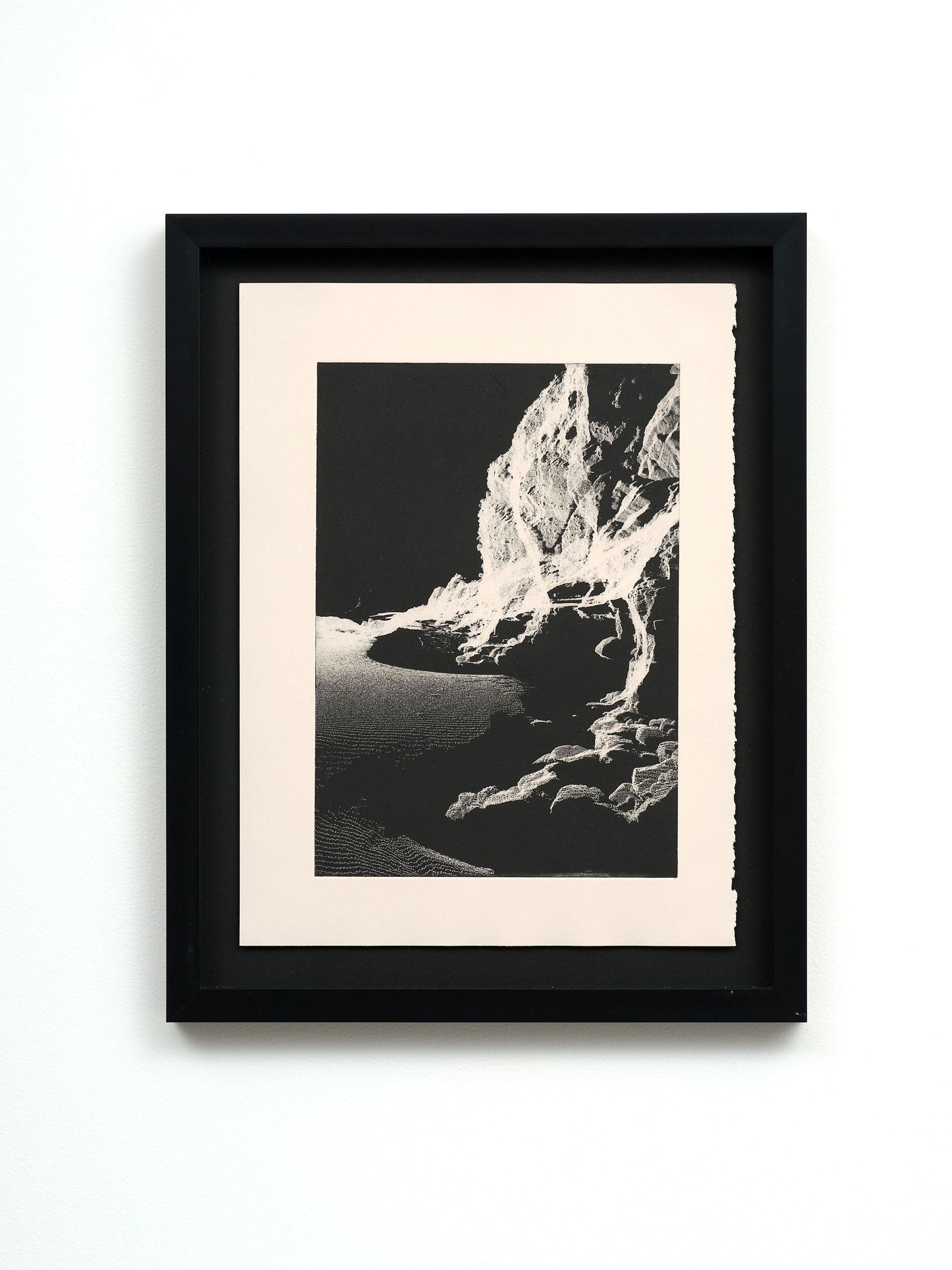
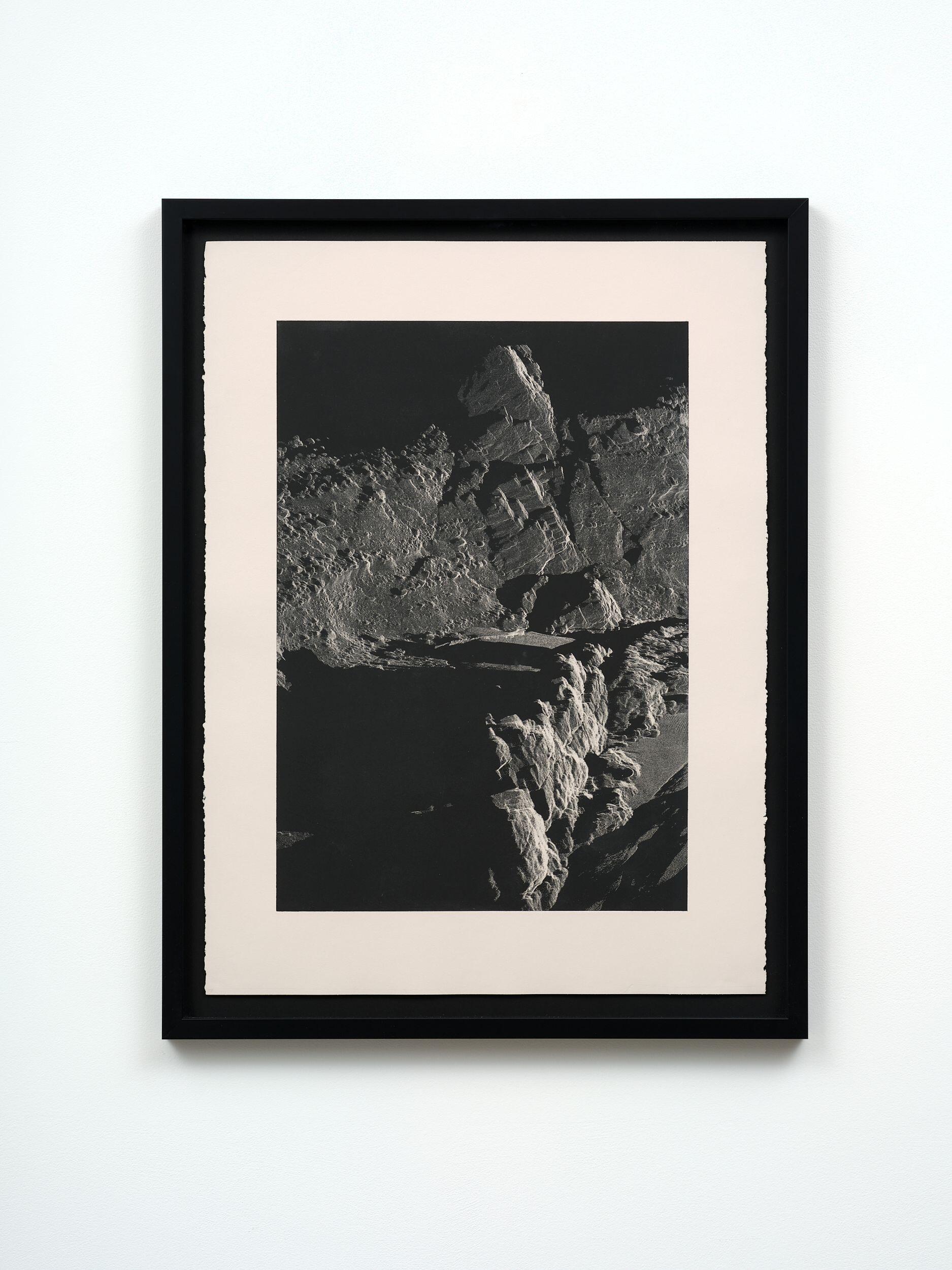
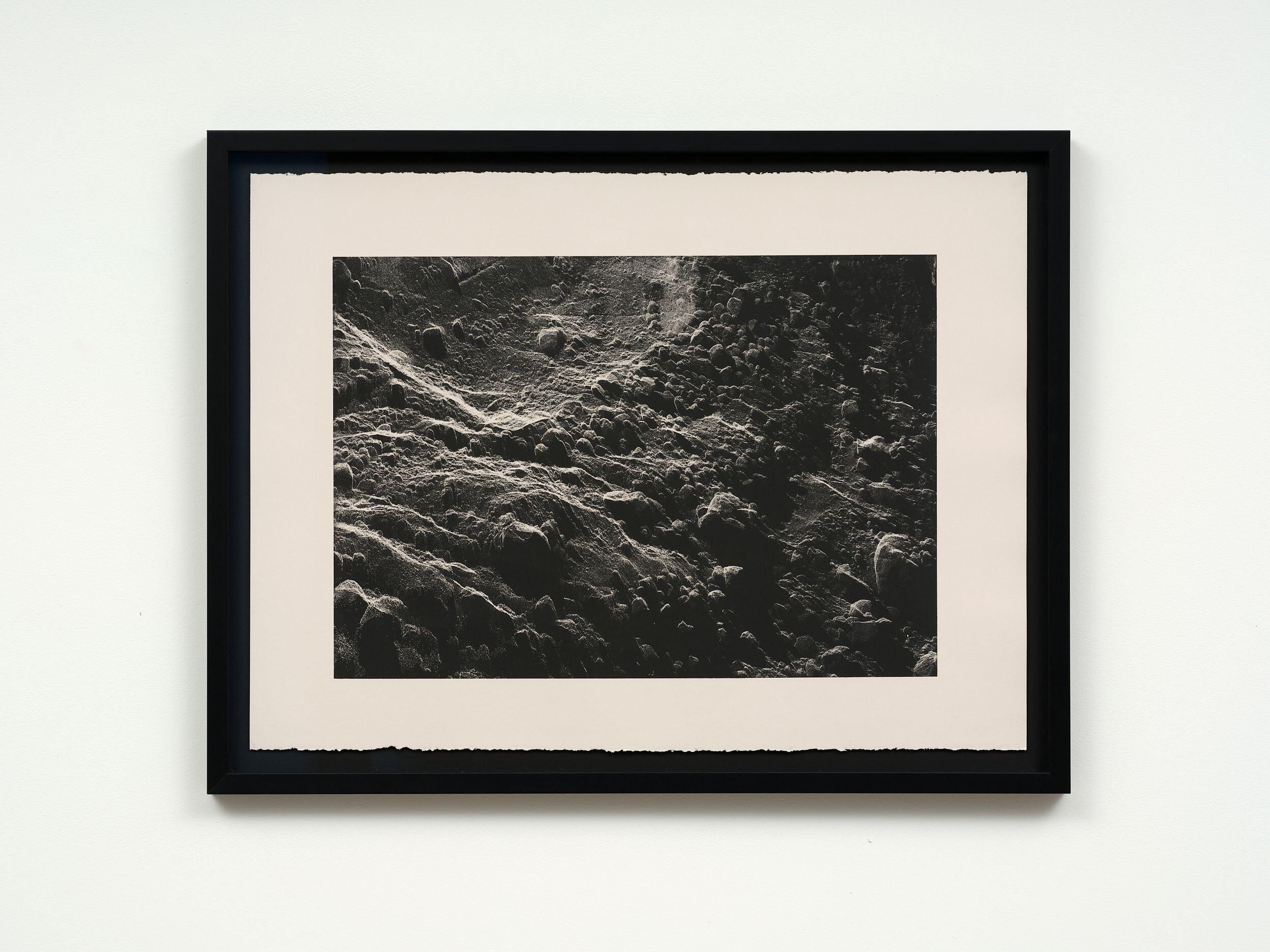
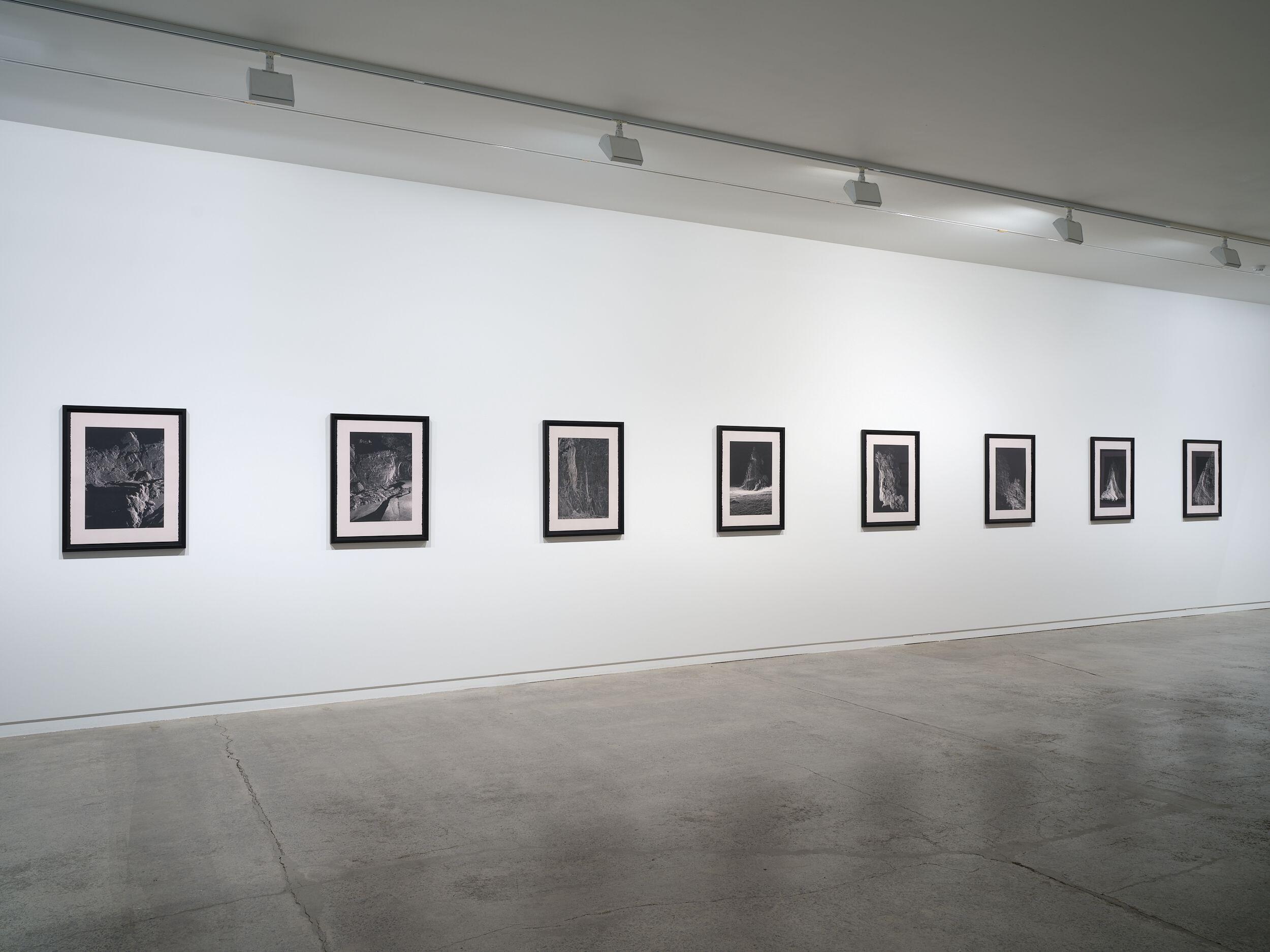
Alongside Campbell’s Dream Diary text works are a suite of landscapes. Sort of. The images are printed using photogravure – arguably the earliest method of photographic reproduction. The process uses intaglio photoetching techniques that result in high contrast and highly detailed etching-like prints. Campbell’s deep explorations of early photographic methodologies arise from an interest in systems of biology and ecology. Working with such processes is an incredibly intricate and unsympathetic combination of materiality, chemistry, experimentation, mastery and luck, with an ever-present tension between the controllable and uncontrollable. You use the materials, but the materials use you, too. The images themselves are of a non-space of slipped time. They’re a constellation of incised textures describing geological formations, weathered surfaces and voids. They could be 17th century architectural etchings as much as they could be 22nd century recordings of celestial bodies. Campbell describes working with Moses, now grown up, to create these images around the Karekare hills using LiDAR technology. An acronym for Light Detection and Ranging, LiDAR collects environmental data by laser light to measure distance, from which a digital three-dimensional model can be stitched together. The model is an interactive digital space, a visual representation of a ‘cloud’ of data points that measure the distance between the physical module and its surroundings. Inside the LiDAR model, Campbell could view this landscape from within its cliffs and from under the sand. Rather than recreating dimensional forms as we experience the world through our human eyes, the environment is mesh-like and sensorially unfamiliar: a new subjectivity.

In ‘Hiding Place’, Campbell dreamt that

I was hiding with Mo in the bush, near a cliff. We went into a small cave. It was green, mossy, and smooth surfaced. Further on I could see a crevice, also green, mossy, and velvety smooth, mirroring the one we were standing in.

I became aware that between the entrance where we stood, and this possible exit was a pit extending above and below. I realised the pit wasn’t just massive, but infinite. 

Te Kore is a void. It is the beginning of time, creation, and it is also chaos. The void is infinite and pregnant with potential. The void is distinct from nothingness, and chaos is distinct from randomness. Chaos, as Halberstam proposes, has the potential for renewal. How might democracy – the space for all voices and experiences – be renewed by the chaos of multiple subjectivities? Are Campbell’s LiDAR images the visualisation of objective perspectives beyond the human experience of space and time, or are they approaching a radical subjectivity of all time and space? 

Māori octopuses (Macroctopus maorum) dig burrows in the seafloor, inhabiting the subsurface space of Campbell’s LiDAR perspectives, as well as the Colac Bay pakohe toki. With their radial arms and almost all-directional vision, octopuses have no ‘forwards’ or ‘backwards’. This way of moving through space is radically different to our own forward-facing two-legged experience of movement, an infinitely expanded directional sensibility through space and time. The birth of an octopus’ off-spring signals death for the mother, who sacrifices her own need for nutrients to protect her babies, thus submitting to the cyclic processes of time, living and dying in the same multidirection way she oriented herself through ocean space. Using movement of the octopus as a metaphor for our human experience of time and space, mental health researcher David Borkenhagen asks, ‘can the liquid motion of the octopus radicalise our ideas about time?’ [4]

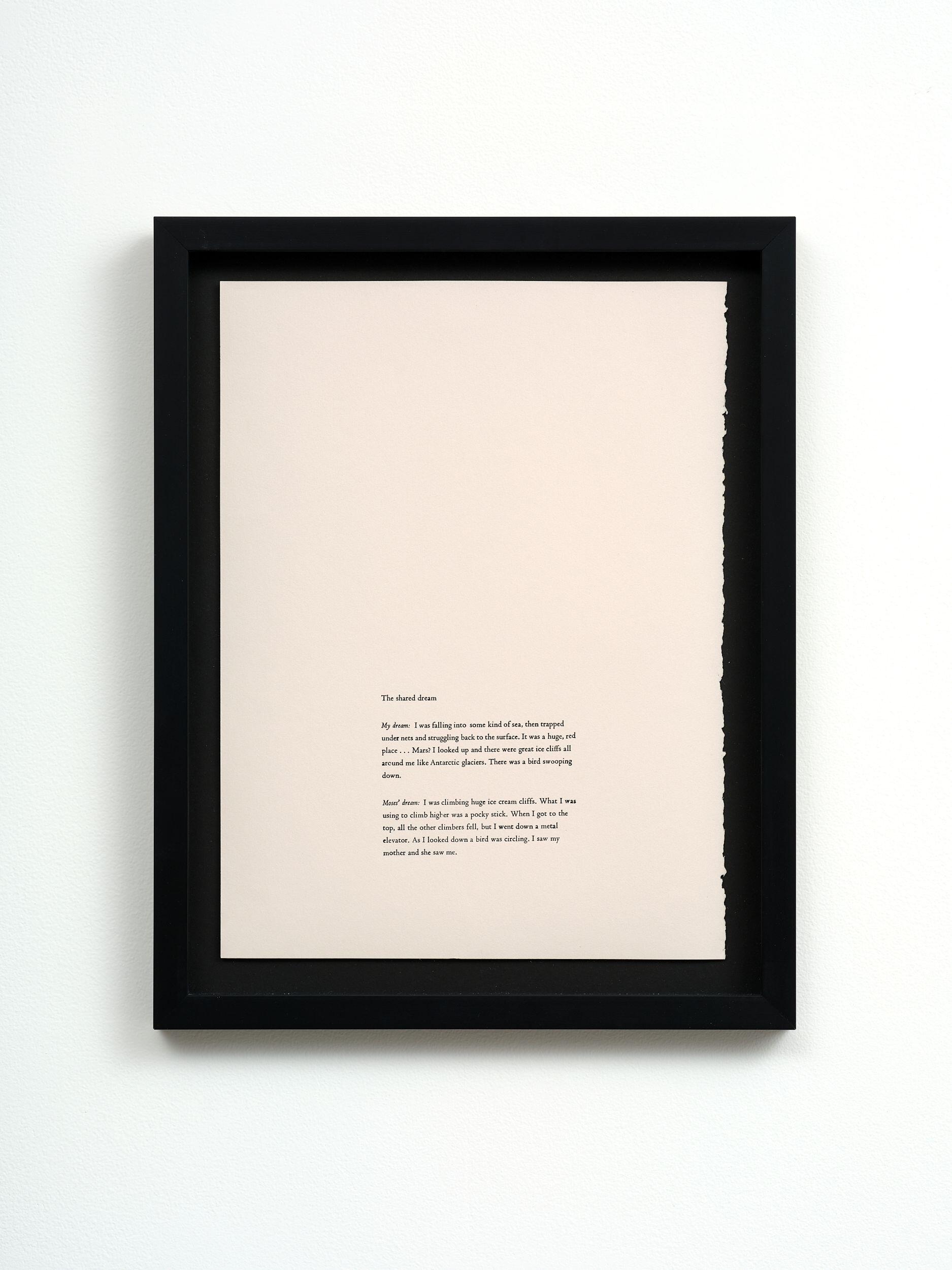
Amongst Campbell’s dream transcriptions is a ‘Shared Dream’ in which she and Moses dreamt remarkably similar landscapes and events, and each see one another in their dream spaces. Campbell: I was in a massive place falling into some kind of sea, then trapped under nets and trying to get back to the surface. It was a huge red place … Mars? I looked up and there were great ice cliffs around me, like Antarctic glaciers. In Moses’ experience of this dream space, he is climbing the cliffs, using a Pocky stick to climb higher. Each of them sees a bird circling, and when Moses looks down from where he has climbed, he sees his mother. I saw my mother and she saw me.

<p>Joyce Campbell, <em>Dream Diary</em>, 2025, courtesy of the artist and Two Rooms Gallery.&nbsp;Photography by Sam Hartnett.</p>

Joyce Campbell, Dream Diary, 2025, courtesy of the artist and Two Rooms Gallery. Photography by Sam Hartnett.

Subjectivity is a democratic provocation. Wells’ farm chores parallel Muriel’s, their lanolin-greased hands digging the same vegetable patch, inviting a radical relationship to time similar to that of the octopus. From an intersectional perspective, this ‘queering’ of time might model Myles’ ‘abstract sum total of all human experience’. [5] Dream Diary makes a similar invitation, to experience both the psyche and one’s environment with a radical subjectivity that traverses technologies, ecologies and intimacies. Radical subjectivity might make space for multiplicity, reject established binaries and actively disregard ‘what power wants’. 

Footnotes

[1] J Halberstam, In a Queer Time and Place, New York, NYU Press, 2005, pp 7–8.

[2] J Halberstam, Gaga Feminism: Sex, Gender, and the End of Normal, Boston, Beacon Press, 2012, https://books.google.co.nz/books?id=ECrU781rQjYC&printsec=copyright&redir_esc=y#v=onepage&q&f=false

[3] B Keane, ‘Traditional Māori religion – ngā karakia a te Māori – Ngā atua – the gods’, Te Ara – the Encyclopedia of New Zealand, teara.govt.nz/en/traditional-maori-religion-nga-karakia-a-te-maori/page-1

[4] D Borkenhagen, ‘Octopus Time,’ Aeon, 20 April 2023, aeon.co/essays/can-the-liquid-motion-of-the-octopus-radicalise-our-ideas-about-time

[5] E Myles, ‘Time Puts Its Stamp on Everything’, The Shabbiness of Beauty: Moyra Davey and Peter Hujar, London, Mack Books, 2021.