Think you know Picasso? Think again.
Discover the artist beyond his famous works and how Sir Paul Smith brings a fresh perspective to his extraordinary career.
You probably know a Picasso when you see one. Even if you couldn’t name a particular painting, there’s a good chance you’d recognise his distinctive style.
But what you might not realise is that Picasso didn’t actually have only one style. Throughout his extraordinary career, he moved between artistic approaches, experimented with different mediums and repeatedly challenged his own ideas about what art could be.
Behind those instantly recognisable paintings is a much bigger story of artistic rebellion, personal relationships and constant reinvention.
Now, Picasso: Designed by Paul Smith at Auckland Art Gallery Toi o Tāmaki invites visitors to discover the artist beyond his most famous works.
Featuring more than 80 paintings, sculptures, drawings, prints and ceramics from the Musée national Picasso-Paris, the exhibition traces the many chapters of Picasso’s life and career. It’s the first solo exhibition of Picasso’s work in Aotearoa New Zealand in more than 30 years.
And there’s another creative mind involved: British fashion designer Sir Paul Smith, whose colourful, unexpected exhibition design offers a fresh perspective on an artist we might think we already understand.
The artist who refused to stand still
Born in Málaga, Spain, in 1881, Pablo Picasso showed remarkable artistic ability from an early age. His father was an art teacher, and by his teenage years Picasso had already mastered many of the technical skills associated with traditional painting.
But for Picasso, mastering the rules wasn’t enough – he wanted to question them. And over a career spanning more than seven decades, he became one of the most influential figures in modern art.
Alongside Georges Braque, Picasso pioneered Cubism, an artistic movement that challenged the convention of representing objects from a single viewpoint. Instead, subjects could be broken apart, examined from multiple angles and reassembled on the canvas. At the beginning of the 20th century, this idea was revolutionary.
Yet – although recognisable – Cubism was only one chapter. Picasso’s work shifted dramatically throughout his lifetime, from the sombre paintings of his Blue Period to the warmer colours of his Rose Period, experiments with sculpture and ceramics, and later reinterpretations of paintings by artists he admired.
A different creative perspective
Known for his signature stripes, playful details and unexpected combinations of colour and pattern, Sir Paul has built a career on questioning conventions, experimenting with colour and finding inspiration in unexpected places.
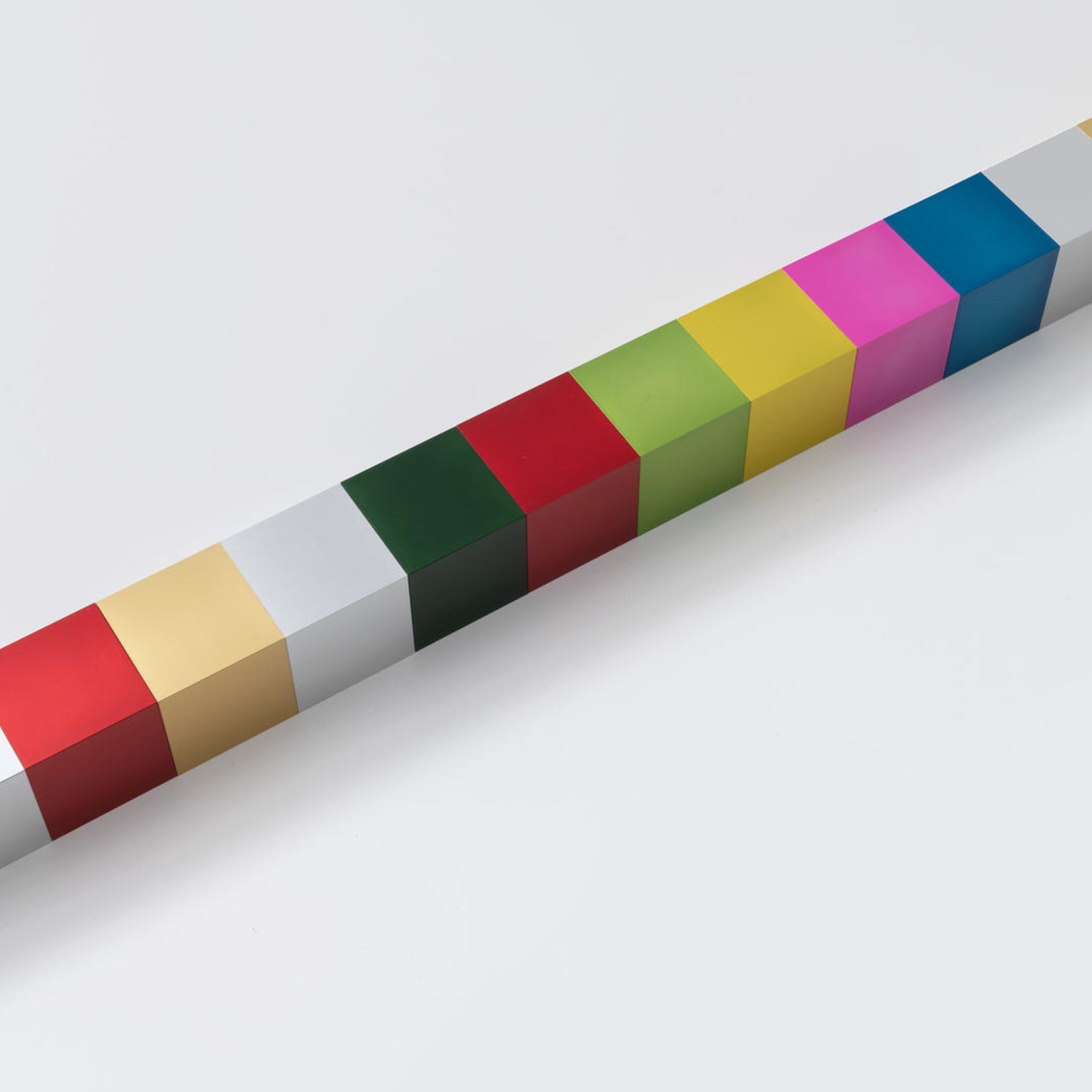
Across 15 uniquely designed rooms, Sir Paul draws on the colours, shapes, patterns and textures of Picasso’s artworks to create an immersive journey through his life and work.
Sir Paul’s carefully considered spaces invite visitors to look again, notice different details and discover sides of Picasso they may never have encountered before.
The Blue Period: Finding beauty in melancholy
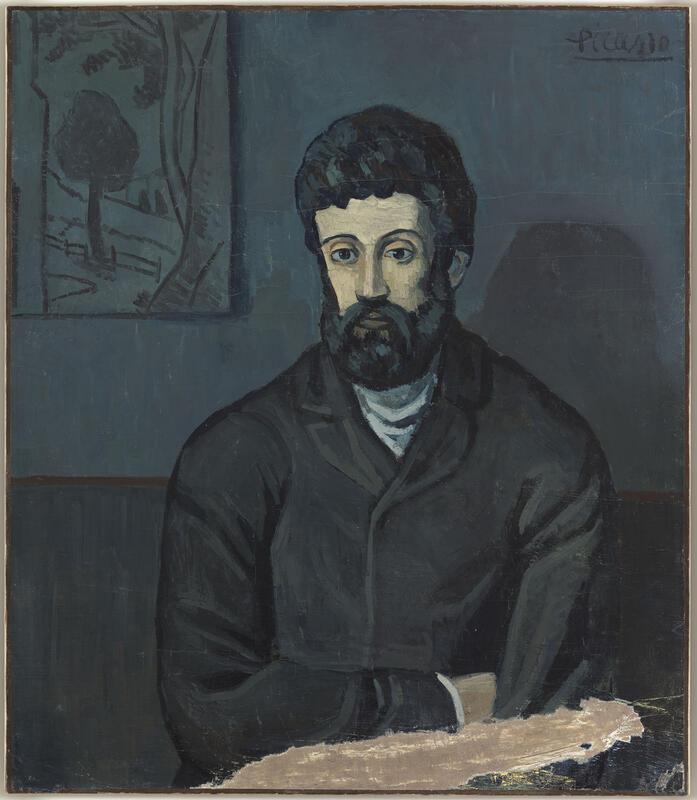
Pablo Picasso, Portrait d’homme, 1902–03, oil on canvas,
Musée national Picasso-Paris © Succession Picasso/Copyright Agency, 2026.
Image credit: © GrandPalaisRmn (Musée national Picasso-Paris) / Mathieu Rabeau.
Between 1901 and 1904, while moving between Barcelona and Paris, Picasso developed what became known as his Blue Period. His paintings from these years are dominated by cool blues and blue-greens, often depicting people living on the margins of society.
The period followed the death of his close friend Carlos Casagemas in 1901, an event that deeply affected the young artist.
In Portrait d’homme, a solitary man sits slumped at a café counter, his arms crossed and his expression one of resignation. His gaze seems to drift beyond the viewer, while the muted blue palette gives the scene a sense of sadness and isolation.
Picasso later described the sitter as a familiar figure on the streets of Barcelona, a ‘madman’ everyone seemed to know.
It’s a far cry from the colourful, fractured portraits most people associate with Picasso. Here, the artist is concerned less with challenging how we see a face and more with what that face might reveal about the human condition.
Look closely at the bottom of the painting and you’ll notice areas where the paint has been lost. The damage occurred early in the work’s life, but Picasso chose not to repair it.
In the exhibition, the painting sits alone against dark walls, illuminated by a soft spotlight. The subdued setting echoes the melancholy of Picasso’s Blue Period, encouraging you to spend a quiet moment with the solitary figure.
From the Rose Period to a radical new way of seeing
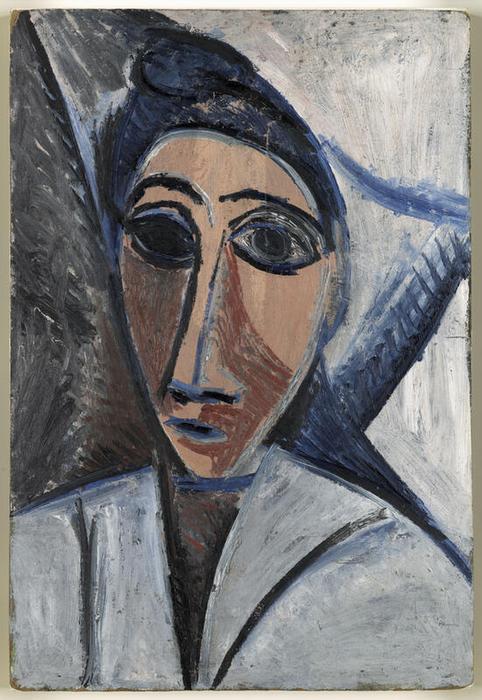
Pablo Picasso, Buste de femme ou de marin (étude pour “Les Demoiselles d’Avignon”),
1907, oil on cardboard, Musée national Picasso-Paris © Succession Picasso/Copyright Agency, 2026.
Image credit: © GrandPalaisRmn (Musée national Picasso-Paris) / Mathieu Rabeau.
By 1904, Picasso’s work was changing. The blues gradually gave way to warmer pinks, oranges and earthy tones, while his subjects shifted towards circus performers, acrobats and harlequins. This became known as the Rose Period, and by 1907, he was exploring something much more radical.
Buste de femme ou de marin, a study associated with his groundbreaking 1907 painting Les Demoiselles d’Avignon, reveals an artist beginning to dismantle traditional ideas about the human figure.
The face is simplified into strong, angular planes. Its contours are sharply defined, while the head has an almost sculptural quality. Rather than creating the illusion of a three-dimensional person, Picasso seems interested in the shapes and structures that make up the figure itself.
His experiments drew on influences including ancient Iberian sculpture, African art and the work of French painter Paul Cezanne.
Even the identity of the figure is uncertain. The title, which wasn’t given by Picasso, translates as ‘Bust of a woman or sailor’, reflecting the ambiguity of its appearance. In fact, in his early studies for the work, Picasso had envisaged a male figure – a sailor – whom he ultimately decided not to include in the final version.
This work offers a glimpse of the thinking that would soon lead to Cubism, one of the most significant developments in 20th-century art. Sir Paul places this period of artistic experimentation against a bold pink backdrop to highlight how Picasso’s style was evolving.
From Cubism to Surrealism, colour and a new perspective on portraiture
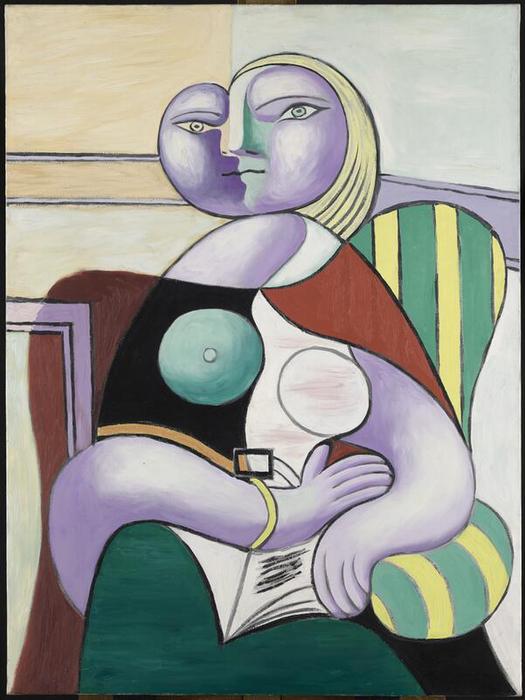
Pablo Picasso, La Lecture, 1932, oil on canvas,
Musée national Picasso-Paris © Succession Picasso/Copyright Agency, 2026.
Image credit: © GrandPalaisRmn (Musée national Picasso-Paris) / Mathieu Rabeau.
By the time Picasso painted La Lecture in 1932, he had spent decades experimenting with Cubism. But rather than the sharp, fragmented compositions of his earlier work, he was finding new ways to combine multiple perspectives with flowing lines, rounded forms and expressive colour. The mid-1920s and 30s were characterised by Surrealism. Picasso associated with several members of the artistic group, and his work closely reflected their new artistic vision of the world: a highly free style of figurative art inspired by dreams and the unconscious.
The subject is Marie-Thérèse Walter, whom Picasso met in 1927 and painted repeatedly as a serene and sensual figure. He frequently depicted Walter using shades of purple and rounded forms, creating a visual language closely associated with her image.
In La Lecture, Walter is shown reading, her body composed of overlapping shapes and curves. Her face appears simultaneously in profile and from the front, while the lines of her figure blend into the chair around her.
It’s an example of Picasso’s continuing fascination with perspective, but there’s a softness here that feels very different from his earlier Cubist experiments. Sir Paul has taken a playful approach, with yellow stripes running down the gallery walls to echo the striped chair in La Lecture.
Reinterpretation of the greats
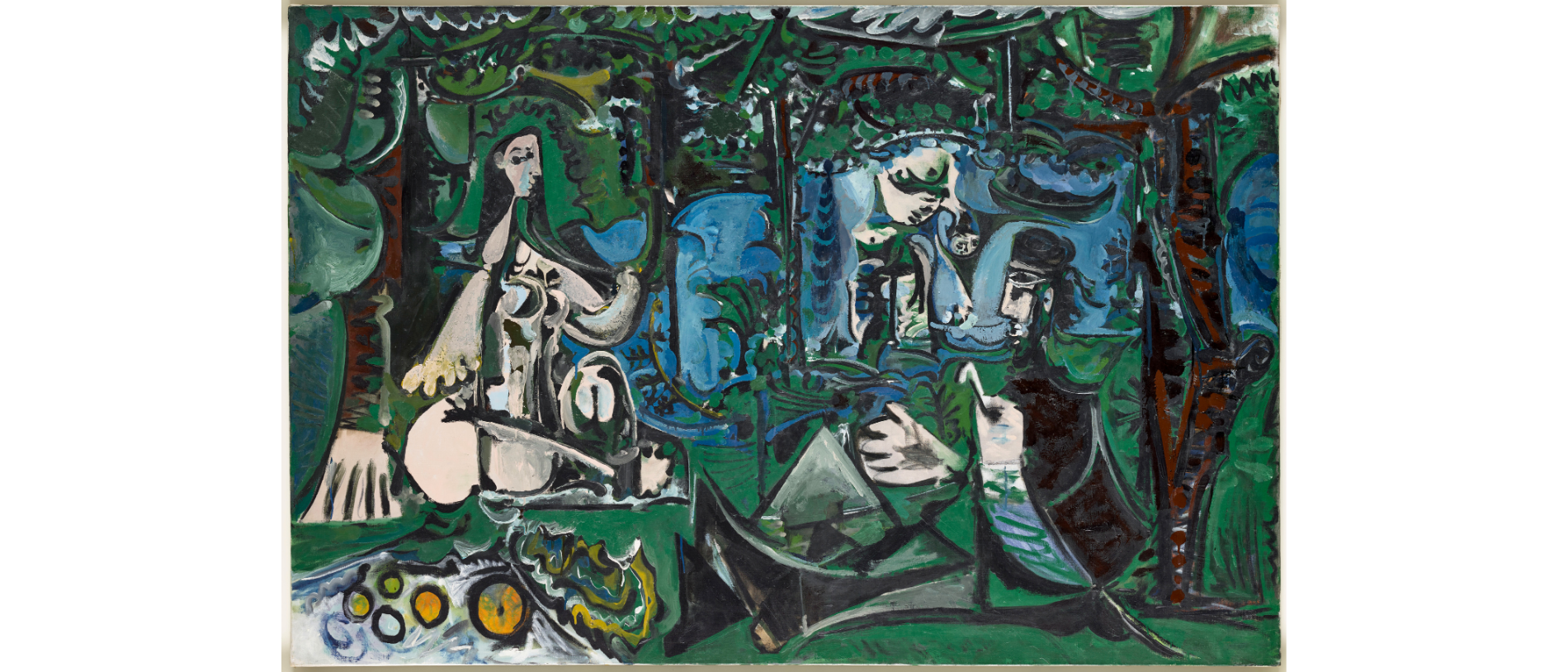
Pablo Picasso, Le Déjeuner sur l’herbe d’après Manet, 1960, oil on canvas, Musée national Picasso-Paris © Succession Picasso/Copyright Agency, 2026. Image credit: © GrandPalaisRmn (Musée national Picasso-Paris) / Mathieu Rabeau.
Throughout his career, Picasso returned repeatedly to the work of artists he admired, taking familiar compositions and reimagining them through his own artistic language.
The original Le Déjeuner sur l’herbe, painted by Édouard Manet in 1863, caused a scandal when it was first exhibited. Its depiction of a nude and a scantily clad woman sitting beside fully clothed men challenged the conventions of respectable painting.
A century later, Picasso created his own provocative interpretation. In this version, Picasso renders the male voyeurs naked, a radically equalising strategy that entirely transforms the sexual balance of power of the original. Deep green walls surround Picasso’s interpretation in this exhibition, creating a rich backdrop for the artwork’s busy composition.
Picasso was rarely interested in arriving at one final, definitive image. He often worked in series, returning to the same subject again and again to explore different possibilities.
As he once said, ‘I am a Spaniard. Just as a torero takes his bull through all kinds of passes, I like to take my pictures through all kinds of variations.’
Discover the Picasso you haven’t met yet
It’s tempting to think of Picasso as an artist whose story has already been told. But there’s much more to his creative vision than his most recognisable works.
Sir Paul’s imaginative exhibition design adds another perspective, encouraging visitors to encounter the artworks through colour, pattern and unexpected visual connections. Across more than 80 works, Picasso: Designed by Paul Smith reveals an artist who was constantly changing direction, revisiting old ideas and experimenting with new ways of seeing.
Whether you’ve admired Picasso for years, remember his work from school or have never quite understood what all the fuss is about, there’s something to discover here.
Picasso: Designed by Paul Smith
Now it's your turn to see these remarkable works up close. See over 80 paintings, sculptures, drawings, prints and ceramics from the Musée national Picasso-Paris, this is a rare opportunity to experience Picasso's extraordinary creativity right here in Tāmaki Makaurau Auckland.
Don't miss the first solo exhibition of Picasso's work in Aotearoa New Zealand in more than 30 years.
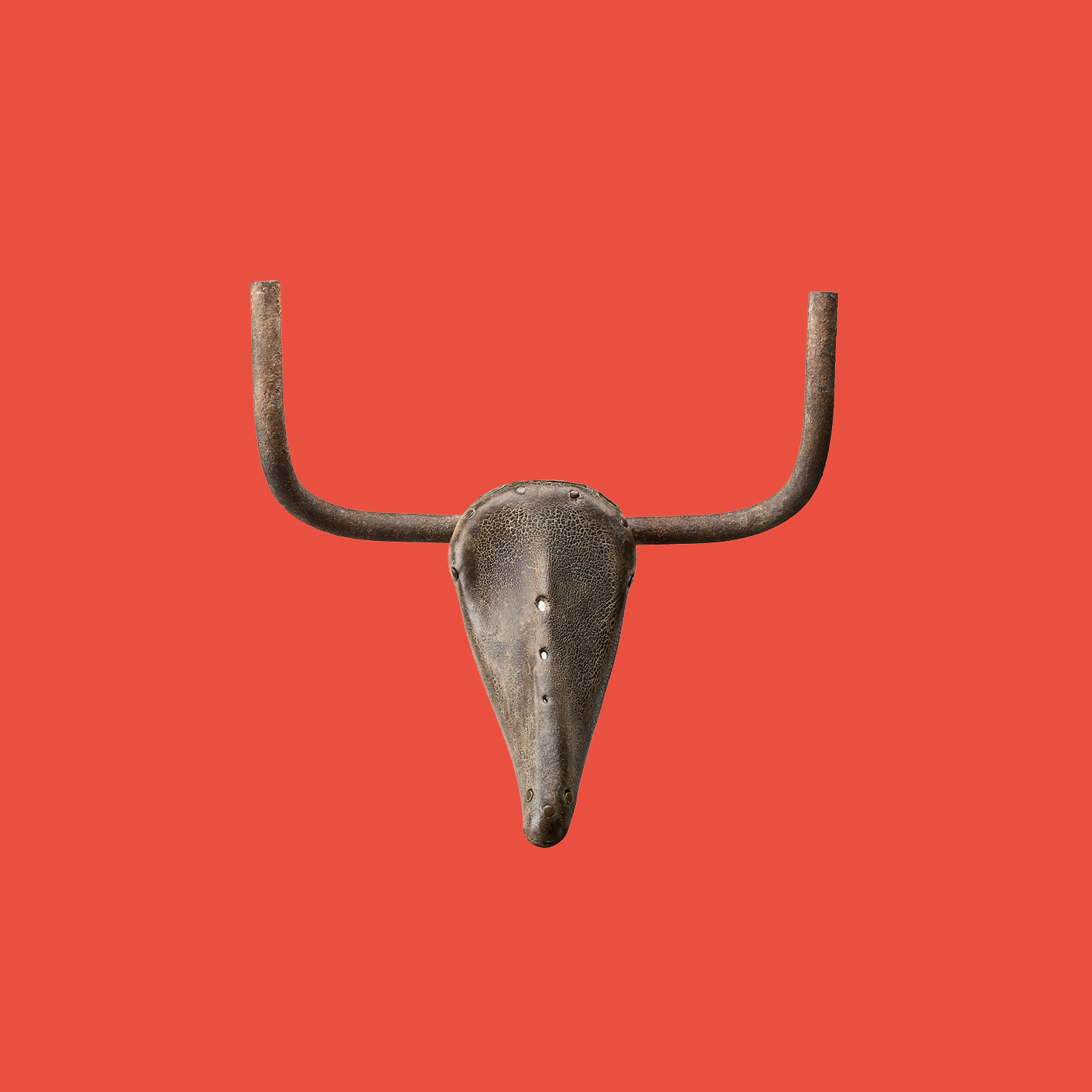
This exhibition is organised by Auckland Art Gallery Toi o Tāmaki in collaboration with the Musée national Picasso–Paris.