Artwork Information
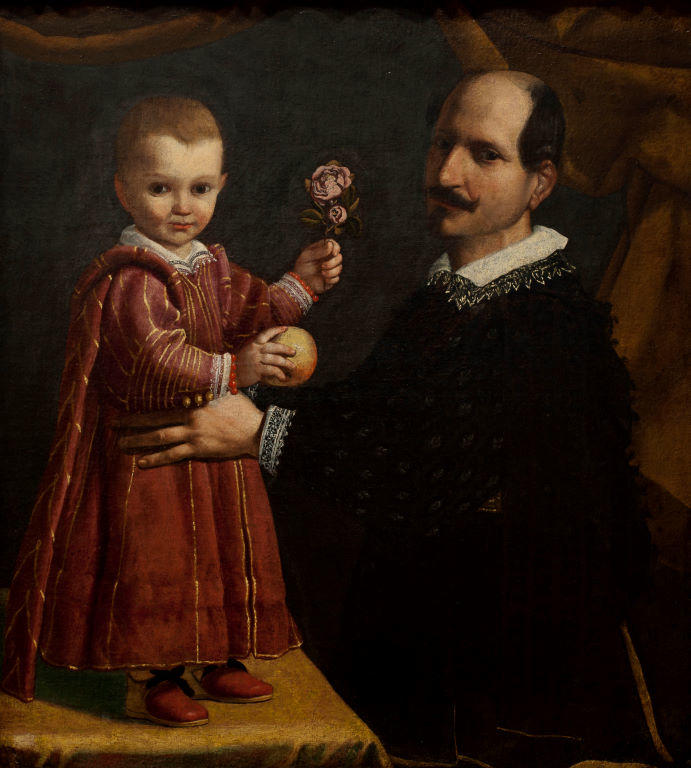
Carlo Ceresa spent much of his time painting Bergamasque nobility, who were drawn towards the gravity represented by the Spanish Court. Humanist scholars, nobles and their families adopted the Court's severe black-and-white costume, which was believed to symbolise an individual's dignity and learning. Man with a Child breaks away from Ceresa's usual formality in ways which are revolutionary in symbolic terms. It was highly unusual for a man to pose with a child of such tender years. Children were more commonly shown in the company of mothers, although whole family groups became more popular in Northern Italy among artists such as Lorenzo Lotto. Because male and female children were dressed identically for the first few years, one cannot ascertain gender by costume. Coral, in the form of bracelets or other items of jewellery, was believed to protect children from illness and harm, and was worn by both sexes. The rose and the apple are symbols of Venus and Eve, possibly indicating that this scholar's child is illegitimate, and therefore the sole property of its father. Even more remarkably, these symbols may indicate that the child is female. In either case, the father's affection for his offspring is apparent in his pose and facial expression. The work may also serve as a commemoration painting for a mother dead in childbirth, but remembered through her child. (from The Guide, 2001)
- Artist
- Carlo Ceresa
- Title
- A Man with a child
- Production Date
- circa 1635
- Medium
- oil on canvas
- Dimensions
- 1190 x 1095 x 80 mm
- Credit Line
- Mackelvie Trust Collection, Auckland Art Gallery Toi o Tāmaki, purchased 1956
- Accession No
- M1956/3/2
- Copyright
- No known copyright restrictions
- Department
- International Art
- Display Status
- On display
More by Carlo Ceresa (1)
A Man with a child
circa 1635
Explore Connections (8)
Men
2215 Artworks

Children (people by age group)
374 Artworks
Cloaks
148 Artworks
Robes
197 Artworks
Flowers (plants)
286 Artworks