Artwork Information
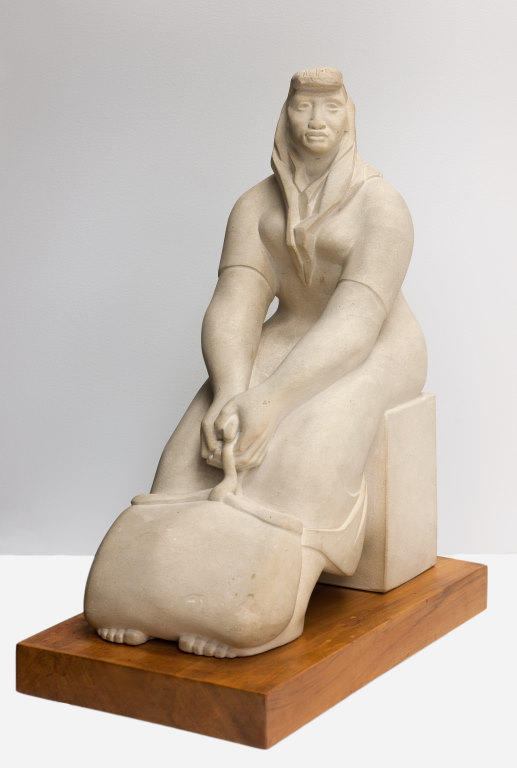
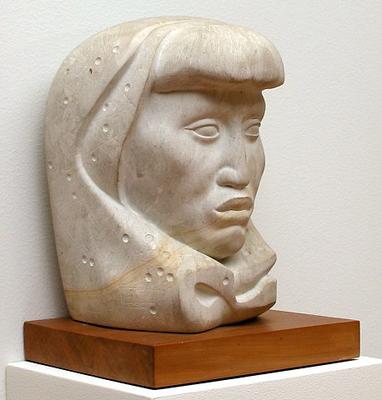
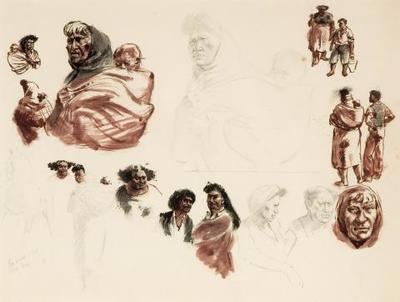
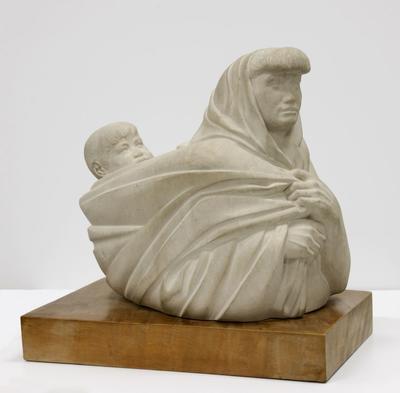
An official war artist during the Second World War and an accomplished sculptor and illustrator, Russell Clark began his career in Dunedin working as a commercial artist. Later he taught at the Canterbury School of Art, where his students included Colin McCahon, Doris Lusk and Pat Hanly. He contributed sketches to the Department of Education's School Journal in the 1940s and his illustrations for the publication Ruatāhuna, a Māori Village were highly acclaimed. Attracted to indigenous New Zealanders as subject matter, Clark portrayed Māori in an unsentimental way. He journeyed to remote rural areas to study his subjects' gestures and expressions and his works revealed them as individuals rather than racial types. A trip into Te Urewera in 1949 provided inspiration for Tūhoe Woman and Head of a Tūhoe Māori, made a year later. Tūhoe Woman is a contemplative work, in which Clark's command of sculptural form is evident. His work underwent many changes of style and he reacted quickly to new media and to the work of other artists. The influence of British sculptor Henry Moore is apparent in his non-figurative works, particularly his public sculpture. The 1958 Anchor Stones, commissioned for the Bledisloe Building in Auckland's Wellesley Street, is a fine example - a tribute to two great Māori migration vessels, Mātāhourua and Tainui. (from The Guide, 2001)
- Artist
- Russell Clark
- Title
- Tuhoe woman
- Production Date
- circa 1957
- Medium
- limestone
- Dimensions
- 335 x 130 x 250 mm
- Credit Line
- Auckland Art Gallery Toi o Tāmaki, The Ilene and Laurence Dakin Bequest, purchased 1996
- Accession No
- 1996/5
- Copyright
- No known copyright restrictions
- Department
- New Zealand Art
- Display Status
- Not on display
More by Russell Clark (10)
Urewera woman
circa 1954
Maori Studies (blue denims, white horse)
circa 1950
Mikado
Date unknown
Maori mother and child
circa 1957
Explore Connections (4)
Women
1863 Artworks
Māori
937 Artworks
Kete
25 Artworks
Headscarves
48 Artworks