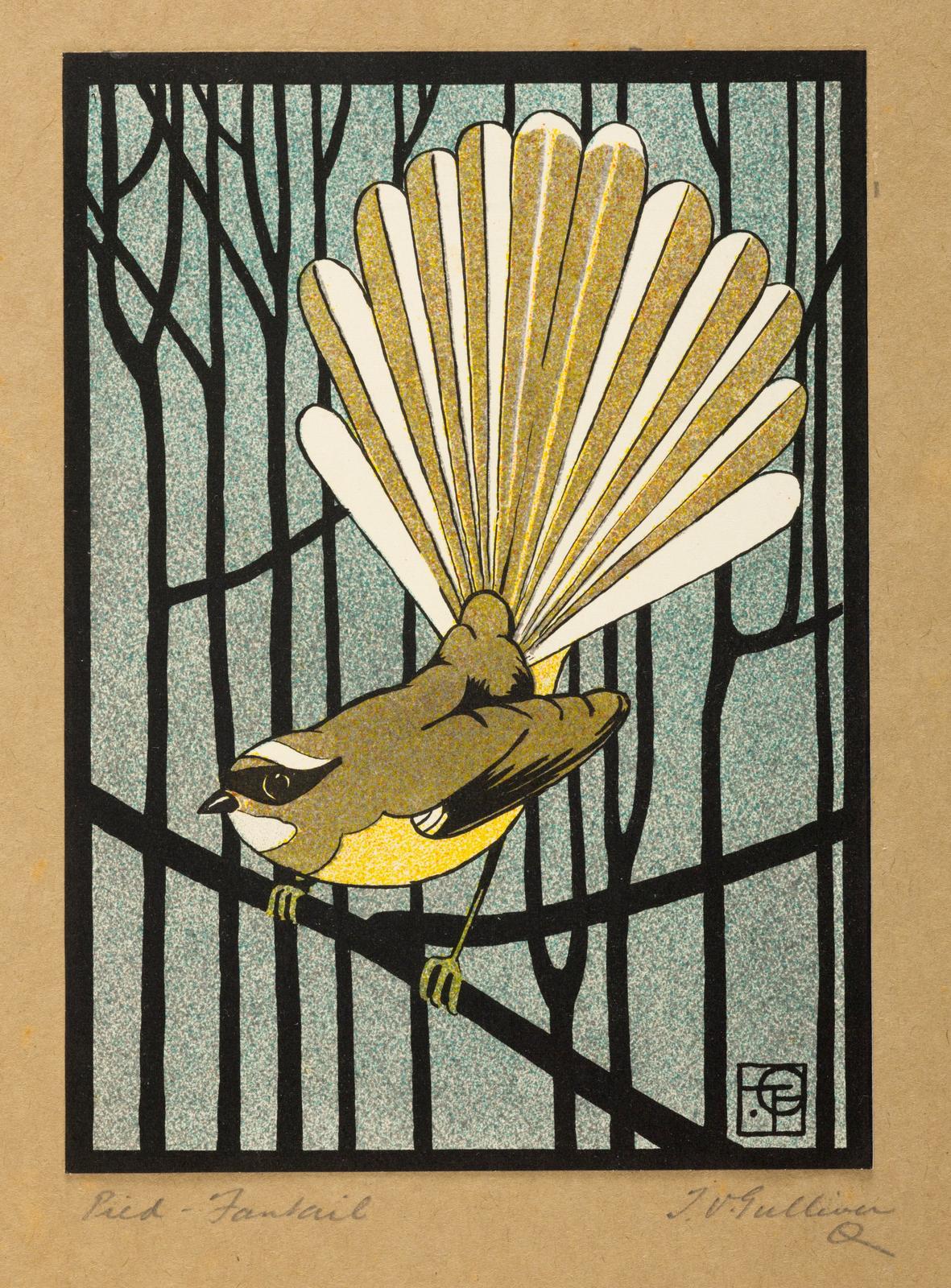
Artwork Information
A civil engineer by profession, Tom Gulliver became a founding member of the Quoin Club, an association of amateur printmakers which flourished in Auckland between 1916 and 1926. This work is from a portfolio of lithographs of native birds produced by the Club in 1919, and its composition and clarity are reminiscent of colour woodcut. Gulliver's interest in making woodcuts was hampered by the scarcity of hardwood blocks in Auckland, although he was sometimes able to trade whisky for discarded blocks from the local newspaper. Here is all the charm of the friendly and inquisitive little fantail - piwakawaka - which follows walkers through the bush, darting about and chirping cheerfully. Gulliver's knowledge of printmaking led to his appointment as Honorary Curator of Prints and Drawings at the Auckland Art Gallery, which was then a part of the Public Library, showing only the City's collection. In 1927 he organised the first temporary exhibition at the Gallery, A Loan Collection of Old and Modern Etchings. Numerous print exhibitions followed, including superb examples of Japanese ukiyo-e woodcuts identified and conserved by Gulliver for a local businessman after they arrived as packaging for imported snuff-bottles. The New Zealand Herald noted in his obituary: 'He was the Dominion's leading authority upon the graphic arts . . . His encyclopaedic knowledge was most remarkable in one who had spent all his life in New Zealand'. (from The Guide, 2001)
- Artist
- Thomas Gulliver
- Title
- Pied Fantail
- Production Date
- 1919
- Medium
- coloured lithograph
- Dimensions
- 182 x 132 mm
- Credit Line
- Auckland Art Gallery Toi o Tāmaki, transferred from the Auckland Public Library, 1932
- Accession No
- 1932/3/3
- Copyright
- No known copyright restrictions
- Department
- New Zealand Art
- Display Status
- Not on display
More by Thomas Gulliver (44)
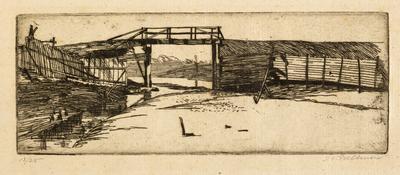
Cox Creek bridge
early 20th century
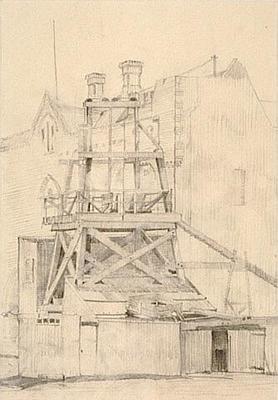
Shortland Street showing the old Post Office building
1920
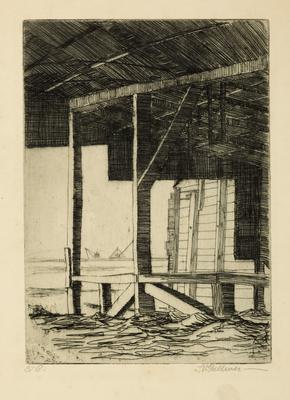
Goldie's Mill
early 20th century
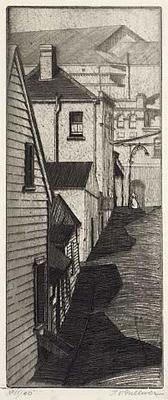
Yelverton Terrace
early 20th century