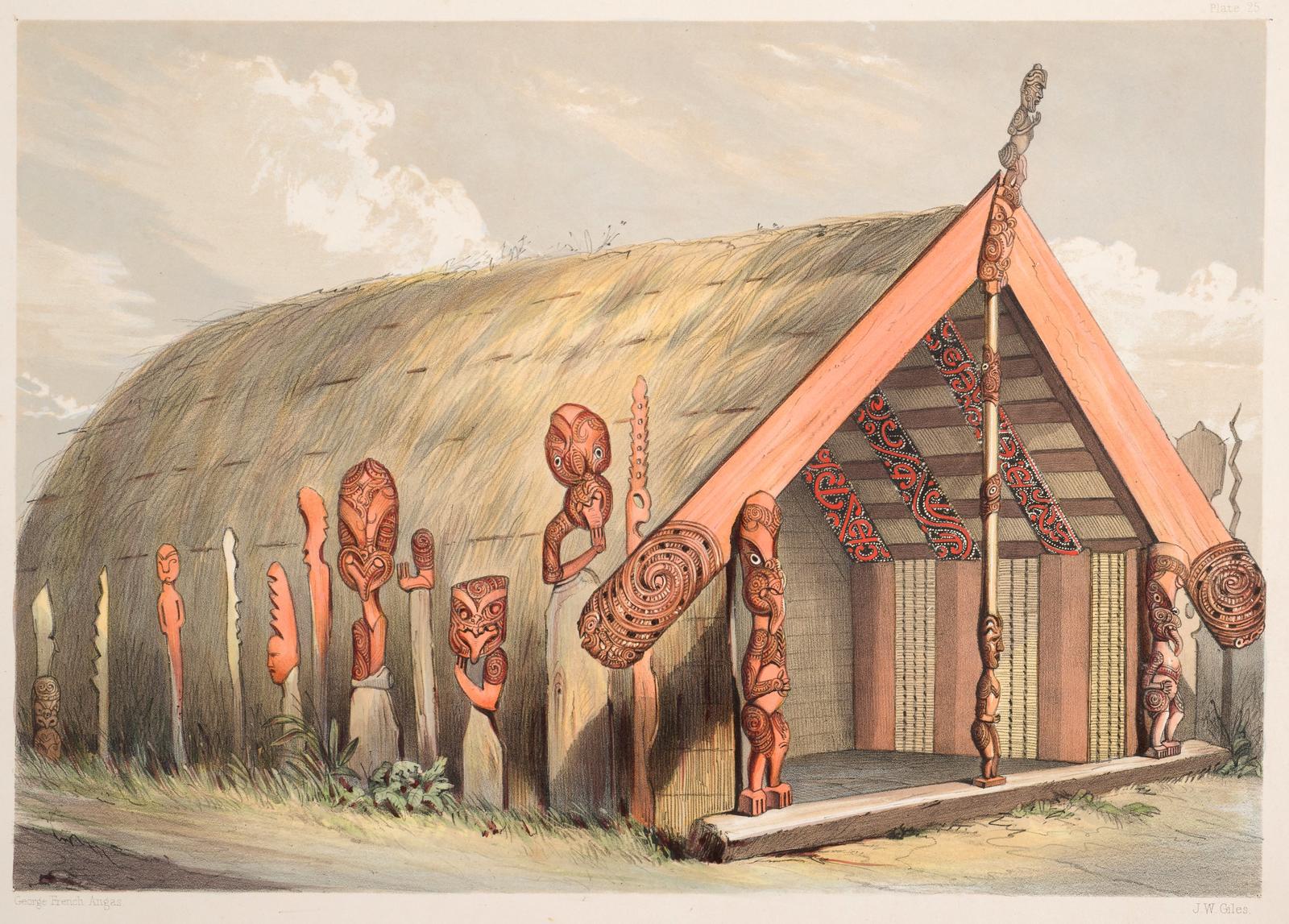
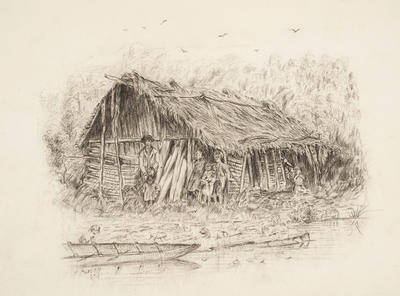
Maketu House, Otawhao Pah, built by Puatia to commemorate the taking of Maketu
1844
Artwork Information
Angas's description:
"PLATE XXV.
MAKETU HOUSE AT OTAWHAO.
THIS remarkable edifice was built by Puatia, the late chief of Otawhao Pah, to commemorate the taking of Maketu on the East Coast. It stands amidst ruin and decay, the only remaining building of any importance that the hand of time has yet spared, within the limits of this once populous Pah. Like all similar carved and painted houses belonging to the New Zealanders, Maketu House is constructed entirely of wood, and thatched with raupo: the interior rafters are beautifully painted with spiral arabesque work, and the carving bestowed upon the figures that so profusely adorn this "war temple," exhibits a wonderful degree of labour and skill.
The two principal figures, with protruding tongues, that are placed on each side of the verandah entrance, are intended to represent Hikarea, a chief of Tauranga, killed at Te Tumu, when three hundred of the enemy fell; and Tarea, another chief, and a friend of Puatia, who was killed at Tauranga. The lower figure supporting the centre pole, is Taipari, a chief of Tauranga, and now a convert to Christianity; he was one of the principal warriors at the taking of Maketu. The two carved spaces further up the pole, are also designed to represent warriors; the upper one is for Tara, who was slain at Taranaki. The figure ornamenting the centre of the gable, represents Puke, killed at Roturua, and the one surmounting the top, Wakatau, who fell at Maketu. Pokana, the present chief of Mata. Mata, then so actively engaged in the Maketu war, has his image under the rafters, inside the verandah, looking down from the ridge pole, with a pipe in his mouth.
The figures surrounding the exterior of the house, are all intended to represent various parties connected with the war, and possess significant meanings.
This remarkable building is "tapu," and has continued so ever since the death of Puatia, by whom it was constructed.
Puatia, during his last illness, embraced Christianity; for several months he lay sick at Otawhao, and was attended by the Rev. J. Morgan, the Church Missionary there; he was then removed to Whatawhata, where he died; his last words to his people were," Receive the word of God, and hold fast on Jesus Christ."
- Artist
- J W Giles, George French Angas
- Title
- Maketu House, Otawhao Pah, built by Puatia to commemorate the taking of Maketu
- Production Date
- 1844
- Medium
- colour lithograph, watercolour, gum arabic
- Dimensions
- 238 x 340 mm
- Credit Line
- Auckland Art Gallery Toi o Tāmaki, purchased with funds from the M A Serra Trust, 1987
- Accession No
- 1987/16/5
- Copyright
- No known copyright restrictions
- Department
- New Zealand Art
- Display Status
- Not on display
More by J W Giles (23)
Roperta of Kawhia. George Thoms a Half Caste Boy. Nephew of Rauparaha
circa 1847
Te Mutu, Chief of the Shutai, with his Sons Patuoni and Te Kuri Hokianga
circa 1847
Motupoi Pah and Roto-aire Lake, Tongariro in the Distance
circa 1847
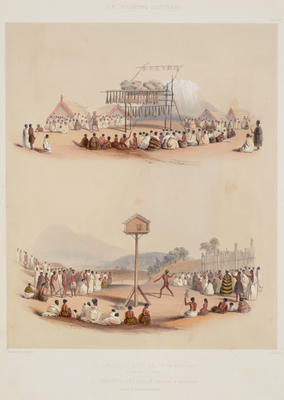
I. A Feast at Mata-Ta, on the East Coast. Mt Edgecumbe in the Distance II. Throwing the Spear, the Mode of Salutation. A Party of Visitors Arriving
1847
Explore Connections (10)
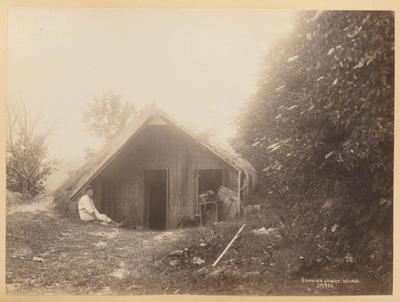
Whare
99 Artworks
Gables (architectural elements)
36 Artworks
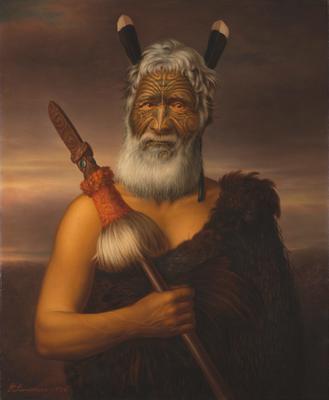
Maihi
14 Artworks
Thatching
37 Artworks
Tekoteko
15 Artworks