Artwork Information
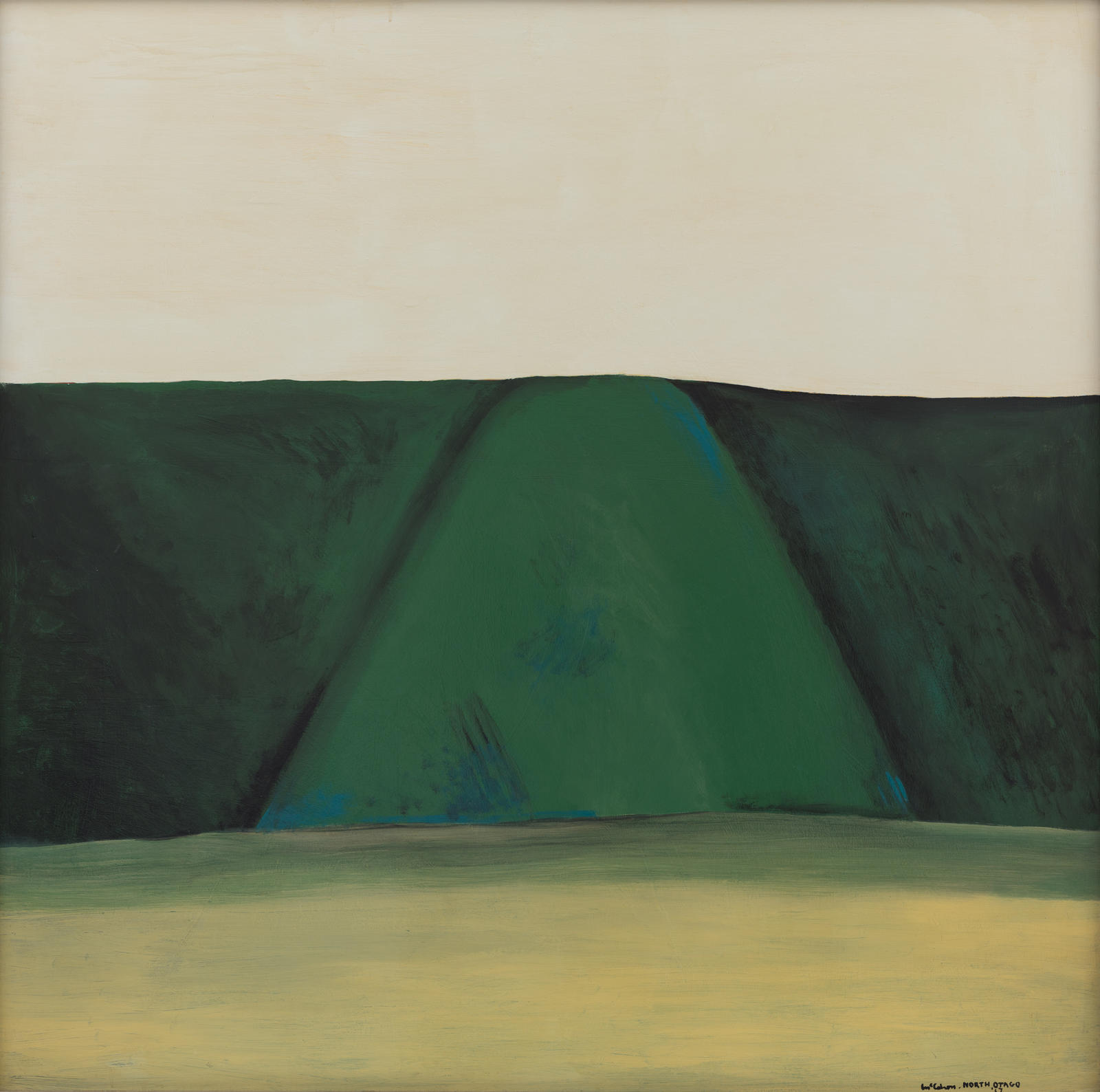
Charles Darwin’s 1859 book On the Origin of Species, which elaborated for the first time the theory of biological evolution, influenced Charles Cotton, a New Zealand earth scientist who believed that landscapes evolve from one form into another, especially as a result of water and soil erosion.
Influenced by Cotton’s publication Geomorphology (1922), Colin McCahon represented landscape as shifting from one form to another. He had lived in north Otago as a child and considered it ‘a unique and lonely place’. After he returning there in 1967 he wrote, ‘The real subject is buried in the works themselves and needs no intellectual striving to be revealed.’
The land erosion in this region is suggested in the foreground plain as a skin covering a flat land, while the distant, still intact hills rise up as if supporting the weight of the sand-coloured sky. McCahon painted similarly shaped hills in the adjacent painting Takaka: night and day, 1948.
- Artist
- Colin McCahon
- Title
- North Otago landscape 4
- Production Date
- 1967
- Medium
- synthetic polymer paint on hardboard
- Dimensions
- 1203 x 1203 mm
- Credit Line
- Auckland Art Gallery Toi o Tāmaki, gift of the artist, 1979
- Accession No
- 1981/12
- Copyright
- Copying restrictions apply
- Department
- New Zealand Art
- Display Status
- Not on display
More by Colin McCahon (237)
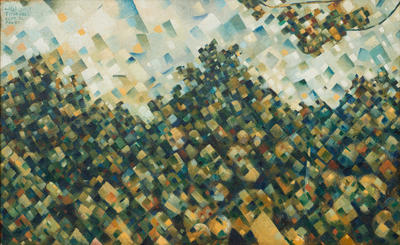
Titirangi
1956-1957

The Fourteen Stations of the Cross
1966
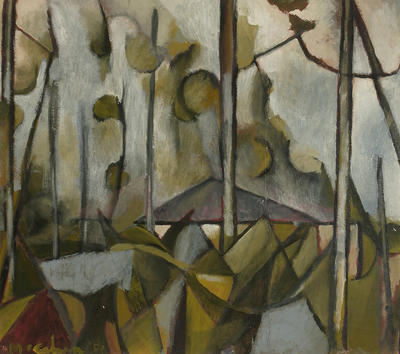
House in trees, Titirangi
1953
![[Flower]](https://artgallery-collection-api.cdn.aucklandunlimited.com/records/images/medium/13244/5b92b1fb1b75605e90f01f7769238072bd5d6348.jpg)
[Flower]
1967