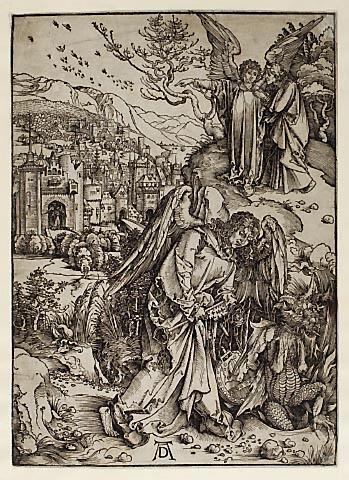
Artwork Information
Apocalypse is the Greek word for a revelation or vision, or for any writing that claims to reveal hidden things imparted by God, especially future events. The Revelation of St John in the New Testament was written around 70 AD, to give courage to the infant Church in the face of bitter persecution, when there was no sign of Christ's imminent return. In the final chapters the Devil, a personification of the Church's enemies, is thrown into the bottomless pit and locked up for 1000 years and an angel shows the weary St John the 'New Jerusalem', Christ's kingdom on earth, which lies ahead. Apocalyptic imagery was widespread at the end of the Middle Ages, a time of religious and political upheaval, with Europe on the brink of the Reformation, which would change the Church for ever. Dürer distilled 15 composite images from the Revelation stories, produced large, action-filled woodcuts, and printed the related biblical texts on the back of the paper; at the age of 27 he was the first artist ever to conceive, illustrate and publish his own book. A supreme master of bold, expressive line, Dürer makes the visions of St John seem real, without destroying their phantasmagoric quality. (from The Guide, 2001)
- Artist
- Albrecht Dürer
- Title
- The Angel with the Key of the Bottomless Pit
- Production Date
- circa 1498
- Medium
- woodcut
- Dimensions
- 392 x 282 mm
- Credit Line
- Auckland Art Gallery Toi o Tāmaki, gift of the Auckland Institute and Museum, 1968
- Accession No
- 1968/8/1
- Copyright
- No known copyright restrictions
- Department
- International Art
- Display Status
- Not on display
More by Albrecht Dürer (51)
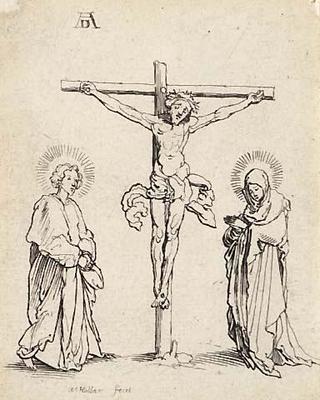
Crucifixion
1642
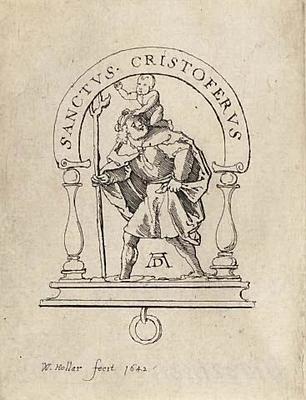
Saint Christopher
1642
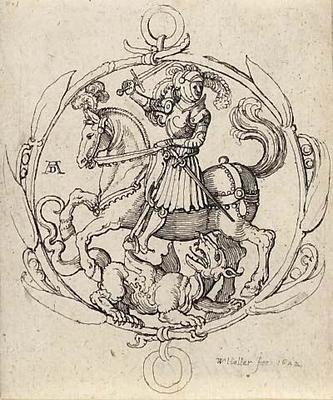
Saint George and the Dragon
1642

Albrecht Dürer the Elder
1640
Explore Connections (8)
Townscapes (representations)
116 Artworks
Towns
235 Artworks
Keys (hardware)
7 Artworks

Wings (costume accessories)
29 Artworks
Cliffs
160 Artworks