Artwork Information
During March 1993 Rob Gardiner of the Chartwell Trust held a survey of Ian Scott’s paintings dating from the years 1986 to 1989. In the exhibition catalogue, collector John Gellert noted that Scott’s art was always a ‘challenge to the viewer’. At that moment post-modernism had become a catchcry within international contemporary art but remained on somewhat shaky ground in New Zealand because of its conflation with issues of post colonialism.
Notions of appropriation, collaging, send-ups, referencing and copying were widely practiced as a form of theoretical re-positioning. Re-use of existing imagery became a primary motivation to complicate codes of visual association at a moment when painting was asking ‘what can be new?’ Post-modernism created a challenging context for New Zealand art in the late 1980s and early 1990s.
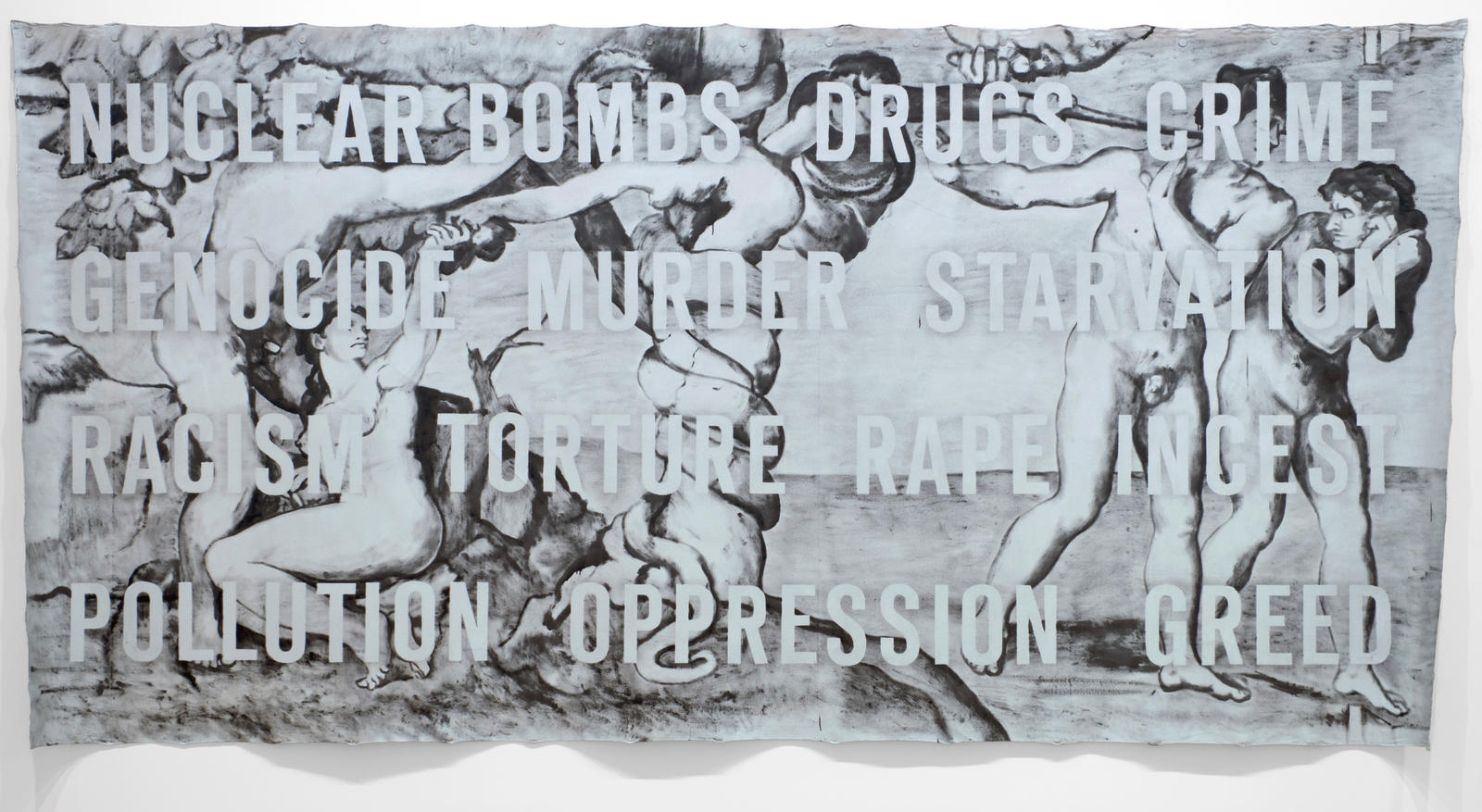
Expulsion is one of Ian Scott’s largest and most politically charged paintings. The utilises the same monochromatic grisaille technique that Pablo Picasso employed in his 1936 Guernica mural. Knowing that sections of Michelangelo’s Sistine Ceiling were similarly painted using a grisaille technique, Scott focused on one of the fresco’s most colourful passages in the Downfall of Adam and Eve and their Expulsion from the Garden of Eden.
Overlaying Michelangelo’s image of a fall from Paradise, Scott places metallic silver sans-serif capital letters stating 13 key dangers to humanity’s survival:
NUCLEAR BOMBS, DRUGS, CRIME, GENOCIDE, MURDER, STARVATION, RACISM, TORTURE, RAPE, INCEST, POLLUTION, OPPRESSION, GREED.
Today, 25 years after Scott’s painting was created, the contrast between this assemblage of threats and what is occurring in the world make the painting into a warning as trenchant as Colin McCahon’s own later word paintings. Instead of the wry humour of Barbara Kruger’s 1980s sloganeering, there is a pathos about the texts in this painting which give it a quelling and timely presence.
In contradistinction, in the same year that Expulsion was exhibited in Christchurch, John Hurrell responded to Scott’s Painter and Signwriter series by proposing that political art could never bring the outside world into the ‘confines of the art gallery’. Looking back, such a response denies the possibility that painting can convey any ethical attitudes to life.
One key to understanding Expulsion is the realisation that humanity is its own worst enemy as so much of what is negative in life is has been caused by humanity itself. The 13 threats are shown as having existed since the beginnings of humanity.
- Artist
- Ian Scott
- Title
- The Expulsion
- Production Date
- 1989
- Medium
- enamel on canvas
- Dimensions
- 2424 x 4880 mm
- Credit Line
- Auckland Art Gallery Toi o Tāmaki, gift of Nan Corson and Chris Corson-Scott, 2014
- Accession No
- 2014/29/3
- Copyright
- Copying restrictions apply
- Department
- New Zealand Art
- Display Status
- Not on display
More by Ian Scott (19)
Lattice No. 90
1982
Track
1968
Sky Dash
1969-1970
Portrait of Don Binney at Te Henga
1969