Artwork Information
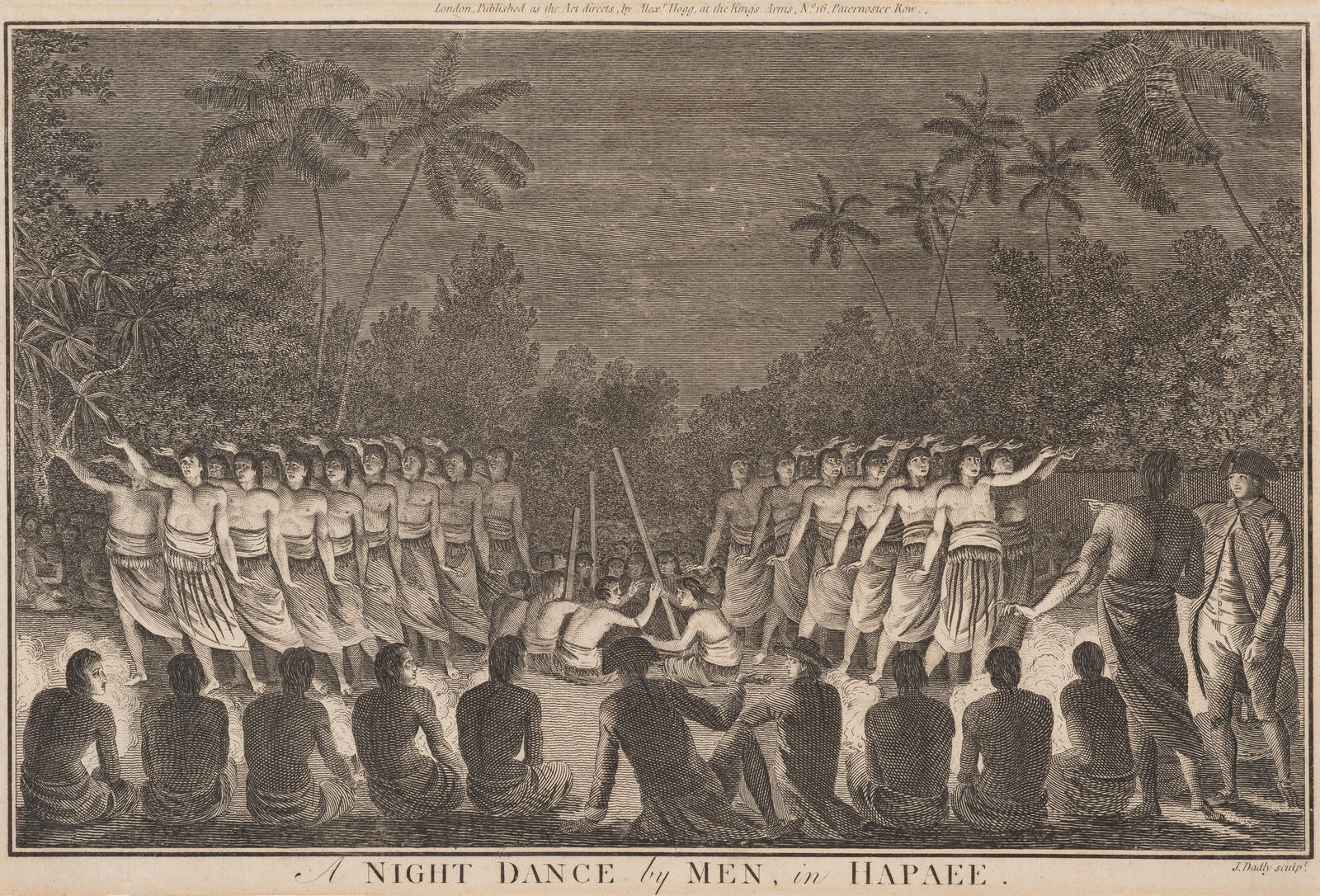
Webber travelled to Ha’apai, one of the islands of Tonga, while employed as an artist on Captain Cook’s third voyage to the Pacific in 1777. While there he completed sketches of the locals and their customs, which were then engraved and published as formal documentation of the exploratory voyage. This engraving records record the performance of a group night dance called the me’elaufola for Captain Cook and his crew. Such ceremonies were part of the protocol innovated for the reception of exploring parties, in which locals and European explorers showcased their authority and forged relationships through impressive displays. Usually performed in a remote location and lit with torchlight, the me’elaufola was thought to harness sacred powers from Pulotu, the Afterworld. The rhythm of the dancers’ feet, extended arm movements, and thuds of bamboo canes escalated to a frenzied crescendo of noise, prompting ecstatic revelations and visions of the spiritual world. In Webber’s engraving the dancers’ bodies are lit from below, shrouding the scene with an atmosphere of anticipation and mysticism.
- Artist
- J Dadly, John Webber
- Title
- A Night dance by men, in Hapaee
- Production Date
- 18th century
- Medium
- engraving
- Dimensions
- 224 x 342 mm
- Credit Line
- Auckland Art Gallery Toi o Tāmaki
- Accession No
- U/65
- Copyright
- No known copyright restrictions
- Department
- New Zealand Art
- Display Status
- Not on display
More by J Dadly (1)
A Night dance by men, in Hapaee
18th century
Explore Connections (9)

Islands
278 Artworks
Palm trees
104 Artworks
Night
350 Artworks
Figures (representations)
2286 Artworks
Men
2215 Artworks