Artwork Information
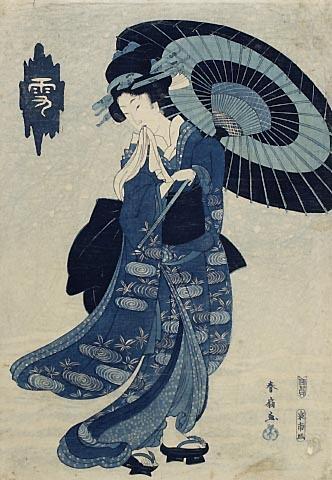
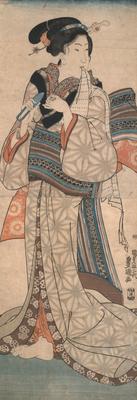
Ukiyo-e (floating world) was the term given to moments of escape from highly structured Japanese society in the seventeenth century. Men could find solace and a temporary sense of control in the company of actors and beautiful courtesans. Colour woodblock prints of figures and events in this milieu were given the same name. Although little is written about Shunsen, he obviously moved away from the actor-genre favoured by his master Katsukawa Shunyei (1768-1819), who depicted performers with bold colours and solid forms. In Lady in a Snowstorm the figure is delicately drawn; if one looks closely, the snowflakes from which her umbrella protects her can be detected against the soft wash of the background. The ideogram in the top left-hand corner says 'Snow'. The bare toes of a geisha were considered particularly erotic, and courtesans were often forbidden to cover their feet, even in winter. The sight of a woman pulling at a piece of cloth with her teeth was also considered beautiful, so that an apparently simple movement to free her busy hands from her sleeve contains coded messages for the knowing spectator. Many French and English artists at the end of the nineteenth century were fascinated with Japanese bijinga (portraits of beautiful women), James Tissot for example depicting them as if viewed for a single moment, before they turn or walk away, out of the spectator's world. (from The Guide, 2001)
- Artist
- Kashösai Shunsen
- Title
- Lady in a snow-storm
- Production Date
- 1811
- Medium
- woodcut - nishiki-e (full colour) technique
- Dimensions
- 368 x 257 mm
- Credit Line
- Mackelvie Trust Collection, Auckland Art Gallery Toi o Tāmaki, purchased 1949
- Accession No
- M36
- Copyright
- No known copyright restrictions
- Department
- International Art
- Display Status
- Not on display
More by Kashösai Shunsen (1)
Lady in a snow-storm
1811
Explore Connections (6)
Parasols
13 Artworks
Umbrellas
30 Artworks
Kimonos
134 Artworks
Courtesans
25 Artworks
Eroticism
16 Artworks