Artist
John Pule
- Name
- John Pule
- Date of birth
- 1962
- Place of birth
- Niue
Jump to
Artworks
Biography
John Pule was born in the village of Liku in Niue and immigrated to Aotearoa New Zealand in 1962 when he was two years old. Largely self-taught, Pule’s expansive interdisciplinary practice has transformed oceanic imaginaries, offering new ways of understanding the arts, cultures and histories of our region.
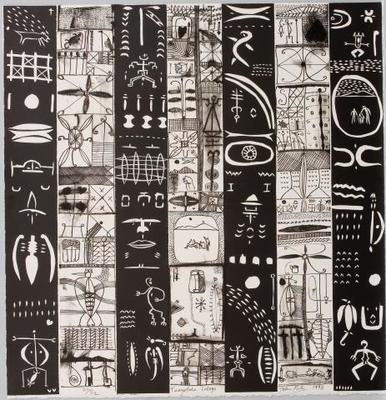
As a poet and novelist, many of Pule’s writings summon the subtle and intimate imagery, colours and textures that coalesced in his paintings from the mid-1980s onwards. These visual sensibilities are evident in early artworks, energised by Pule’s focus on hiapo (decorated Niuean tapa cloth) of the 19th century. He likened the unique composition of hiapo to architecture, combining its rough grid structure with personal iconography in ways that politicised tapa.
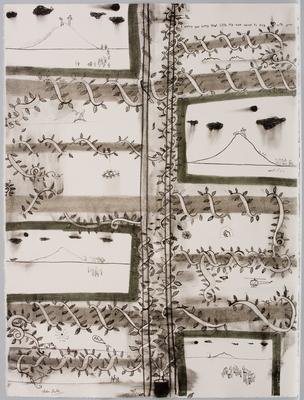
From the 2000s, there was a tonal shift in Pule’s paintings, characterised by surreal cloudscapes and often dominated by a single colour. Clouds, which could be celestial or nuclear, hover in the sky, dripping with the tendrils of the ti mata alea plant (Cordyline fruiticosa), a significant plant in the creation narratives of Niue.
Pule’s stature as one of Aotearoa New Zealand’s most significant artists has been affirmed through sustained critical recognition and accolades. His work is held in major public collections across Australasia, including Auckland Art Gallery Toi o Tāmaki, the Museum of New Zealand Te Papa Tongarewa, the National Gallery of Victoria and the Queensland Art Gallery. Pule’s career highlights include his critically acclaimed survey exhibition Hauaga (Arrivals) in 2010 at City Gallery Wellington and the accompanying monograph. In 2012, he was awarded the New Zealand Order of Merit for services to the arts. When Pule became an Arts Foundation Laureate in 2004, he was the first of Pacific descent to receive the award, paving the way for generations of Pacific artists.
Artworks by John Pule (19)

Next artist